Discussion on the law that applies to or affects Australia's emergency services and emergency management, by Michael Eburn, PhD, Australian Lawyer. Email: meburn@australianemergencylaw.com
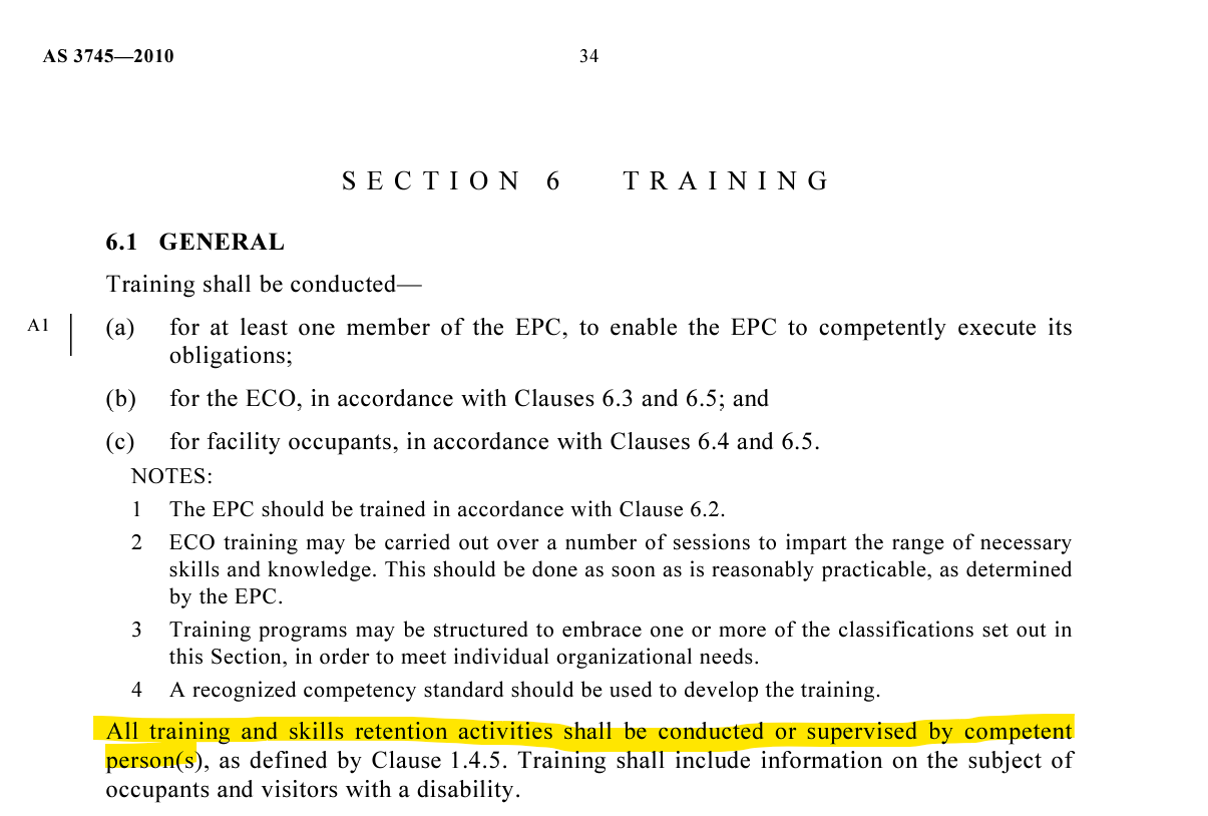
… have struggled to find absolute clarity on since I have returned to the world of AS3745:2010 training post COVID. I would like to know if Emergency Warden training hosted purely by an LMS [Learning Management System] (i.e. a SCORM [Sharable Content Object Reference Model] file or set of videos) satisfies Section 6.1 requirements (see below snip).
I fully understand that this doesn’t apply to whole staff ‘awareness training’, but I really can’t imagine that a generic LMS solution would satisfy the above highlighted.
Can you please confirm that annual online Chief Warden, ECO [Emergency control organization], Emergency Warden etc LMS online training (with no live support or content) is or isn’t enough to satisfy the minimum standard requirements (acknowledging that this standard isn’t legislated in most states) but in some states like NSW required to satisfy the WHS Act.
The search for ‘absolute clarity’ is misguided. The law is often not absolutely clear and intentionally so. The objective to be met may be set out but the way to get there is not as that allows different sectors, and different players to find different ways to achieve the required objective. Remote learning technology has come a long way and will go much further so no-one wants to say, with ‘absolute clarity’ that it cannot be used.
I cannot therefore confirm whether ‘annual online Chief Warden, ECO, Emergency Warden etc LMS online training (with no live support or content) is or isn’t enough to satisfy the minimum standard requirements’ but I can make some observations.
To start with [6.1] and the requirement that all training ‘shall be conducted or supervised by competent persons’. Competent persons means [1.4.5]:
A person who has acquired through training, education, qualification, experience, or a combination of these, the knowledge and skill enabling him/her to correctly perform the required task.
A competent person may well be presenting the online training, and it may have been designed by competent persons to deliver relevant key messages. If a person really is doing the training on their own on a computer there would certainly be a question of whether the training is ‘supervised’ but the need for supervision is an ‘or’ ie ‘All training and skills retention activities shall be conducted or supervised by competent person(s)’. If for example a trainee is doing the training, then supervision by a competent person is required. But if a competent person has approved the content and is delivering the online content then training is being ‘conducted’ by a competent person.
Training for the Emergency planning committee (EPC) and for members of the ECO needs to be site specific including training on installed systems (see 6.2] and [6.3.1.2]). There is an obligation to provide site specific training materials, and these may be in electronic form ([6.7]).
Training for members of the ECO ‘shall include exercises and assessment’ [6.3.1.2] but even these could be done via a well-developed online learning program.
The emergency response arrangements have to be tested. Paragraph 7.1 says:
A program of site-specific emergency response exercises shall be developed in collaboration with the facility owners, managers, occupiers and employers each facility to determine the effectiveness of the emergency response procedures, ECO actions and occupants’ response, both when first developed and on an ongoing basis.
Discussion
There is no clear rule that says ‘training hosted purely by an LMS (i.e. a SCORM file or set of videos) satisfies [or does not satisfy’ the requirements of AS3745. Whether it does or does not would depend on the nature of the site-specific risks and procedures and the quality of the training tools. I have no idea what can be achieved with virtual reality headsets and AI!
I can see the issue that training is to be ‘supervised’ and for members of an ECO is to involve exercises and assessment. One can certainly wonder whether a warden, communications officer or first attack firefighter can really be trained via an online delivery but it’s not for me to say one way or the other. If I were to say ‘no they cannot’ it may reflect more on my poor understanding of what’s possible than the law.
Section 6 of the Standards prescribes the required outcome of the training, not the route by which that training is delivered. Different people with different learning styles may learn much more in the online environment than in a face to face session; and vice versa. It really is up to those delivering the training to determine if they are delivering training that covers the prescribed content and whether it is effective for learners. Plenty of training, however it is delivered, can be a simple ‘tick box’ exercise to say it’s been done even if it is ineffective.
The critical issue is whether the content is delivered and whether the learners are then competent to perform their tasks. That is, or should be, determined in the required emergency response exercises.
Emergency Warden training hosted purely by an LMS’ satisfies the requirements of the standard if it delivers the content prescribed by the standard ([6.3.2]) and if, at the end of the training, the person is competent to perform the tasks assigned.
Our company, (ACTWELL – Canberra based) develop site-specific online training for ECO’s, that addresses ECO roles and responsibilities, evacuation and lockdown procedures, various types of emergencies and associated response procedures, and even ‘first-attack’ fire response.
We certainly encourage our clients to take a ‘blended’ approach, and advocate the importance of face-to-face, ‘hands-on’ training, to better ensure the understanding of important systems including the operation of EWIS panels (Emergency Warning Intercommunication System), OWS (Occupant Warning System), WIP’s (Warden Intercommunication Phones), and installed site-specific emergency equipment such as extinguishers, fire blankets and spill-response kits.
The training liability posed by AS 3745 is significant to say the least. ECO members are required to participate in some form of training on a 6-monthly basis that should address roles, responsibilities, procedures and communications. ALL occupants are required to undertake annual ‘awareness training’, plus there are regular exercises to be conducted. So reducing the face-to-face component to once per year, or in some cases to once every 2 or 3 years, is often very appealing, and may increase the likelihood of actually meeting the requirements.
But, we have all experienced the often sub-par, low quality and uninspiring online learning that plagues workplaces all over Australia. We have piggy backed off other LMS systems to offer this service to our clients in the past, but what we found was that the quality was typically so poor, and the content was no where near site-specific enough, in order to ensure we were actually keeping our clients competent. This sort of low quality training could not possibly achieve the desired results, and was not increasing the likelihood that any organisation were better preparing their team to respond to potential workplace emergencies.
So we decided to develop our own high-quality, in depth, customisable, and highly engaging online learning material to help reduce the enormous ‘training liability’ that many of our clients face.
We are just about to launch our LMS to several of our clients, and will continue to develop the content, quality, and breadth of topics and types of training that we can deliver in this format. But through our beta phase of development, the feedback we are getting is excellent, and we are already seeing improved learner outcomes from of our current users.
I am of the opinion that if the content is well developed, well presented, site-specific, and engaging, there is absolutely merit in providing online learning for emergency preparedness.
The reality is, that very few organisations actually meet the full requirements of AS3645-2010 without some form of online learning to supplement any face-to-face requirements, but often the online content is there to simply tick the box as Michael pointed out. But with a well developed LMS, it really can be a powerful resource, and for some smaller/low risk organisations, a fully online approach to training (minus exercises) MAY be perfectly suitable, as well as more achievable.
We find that at least supplementing training with online learning for skills retention purposes, greatly increases the overall ability of the client to meet the requirements by making it more achievable. But with a good quality LMS and customised, engaging content, we can genuinely increase occupant safety and better prepare them for potential workplace emergencies.
Would I recommend 100% online learning to our clients? Typically, not in most circumstances. But we certainly advocate its inclusion in the overall program to help manage cost and time requirements associated with regular face-to-face training, and to increase the likelihood of meeting the demands of AS3745 WITHOUT just ticking boxes.


 Australian Emergency Law
A well written response, Michael.
Our company, (ACTWELL – Canberra based) develop site-specific online training for ECO’s, that addresses ECO roles and responsibilities, evacuation and lockdown procedures, various types of emergencies and associated response procedures, and even ‘first-attack’ fire response.
We certainly encourage our clients to take a ‘blended’ approach, and advocate the importance of face-to-face, ‘hands-on’ training, to better ensure the understanding of important systems including the operation of EWIS panels (Emergency Warning Intercommunication System), OWS (Occupant Warning System), WIP’s (Warden Intercommunication Phones), and installed site-specific emergency equipment such as extinguishers, fire blankets and spill-response kits.
The training liability posed by AS 3745 is significant to say the least. ECO members are required to participate in some form of training on a 6-monthly basis that should address roles, responsibilities, procedures and communications. ALL occupants are required to undertake annual ‘awareness training’, plus there are regular exercises to be conducted. So reducing the face-to-face component to once per year, or in some cases to once every 2 or 3 years, is often very appealing, and may increase the likelihood of actually meeting the requirements.
But, we have all experienced the often sub-par, low quality and uninspiring online learning that plagues workplaces all over Australia. We have piggy backed off other LMS systems to offer this service to our clients in the past, but what we found was that the quality was typically so poor, and the content was no where near site-specific enough, in order to ensure we were actually keeping our clients competent. This sort of low quality training could not possibly achieve the desired results, and was not increasing the likelihood that any organisation were better preparing their team to respond to potential workplace emergencies.
So we decided to develop our own high-quality, in depth, customisable, and highly engaging online learning material to help reduce the enormous ‘training liability’ that many of our clients face.
We are just about to launch our LMS to several of our clients, and will continue to develop the content, quality, and breadth of topics and types of training that we can deliver in this format. But through our beta phase of development, the feedback we are getting is excellent, and we are already seeing improved learner outcomes from of our current users.
I am of the opinion that if the content is well developed, well presented, site-specific, and engaging, there is absolutely merit in providing online learning for emergency preparedness.
The reality is, that very few organisations actually meet the full requirements of AS3645-2010 without some form of online learning to supplement any face-to-face requirements, but often the online content is there to simply tick the box as Michael pointed out. But with a well developed LMS, it really can be a powerful resource, and for some smaller/low risk organisations, a fully online approach to training (minus exercises) MAY be perfectly suitable, as well as more achievable.
We find that at least supplementing training with online learning for skills retention purposes, greatly increases the overall ability of the client to meet the requirements by making it more achievable. But with a good quality LMS and customised, engaging content, we can genuinely increase occupant safety and better prepare them for potential workplace emergencies.
Would I recommend 100% online learning to our clients? Typically, not in most circumstances. But we certainly advocate its inclusion in the overall program to help manage cost and time requirements associated with regular face-to-face training, and to increase the likelihood of meeting the demands of AS3745 WITHOUT just ticking boxes.