
I have previously written about the work of Dixon’s Hazard Response(“Dixon’s”(and see Citizen’s hazard response service(May 13, 2022)). I have been asked to provide an ‘update’ in light of two letters that are circulating on the web and that have been posted on Dixon’s Facebook page. The letters, which have been sent to me are set out below.
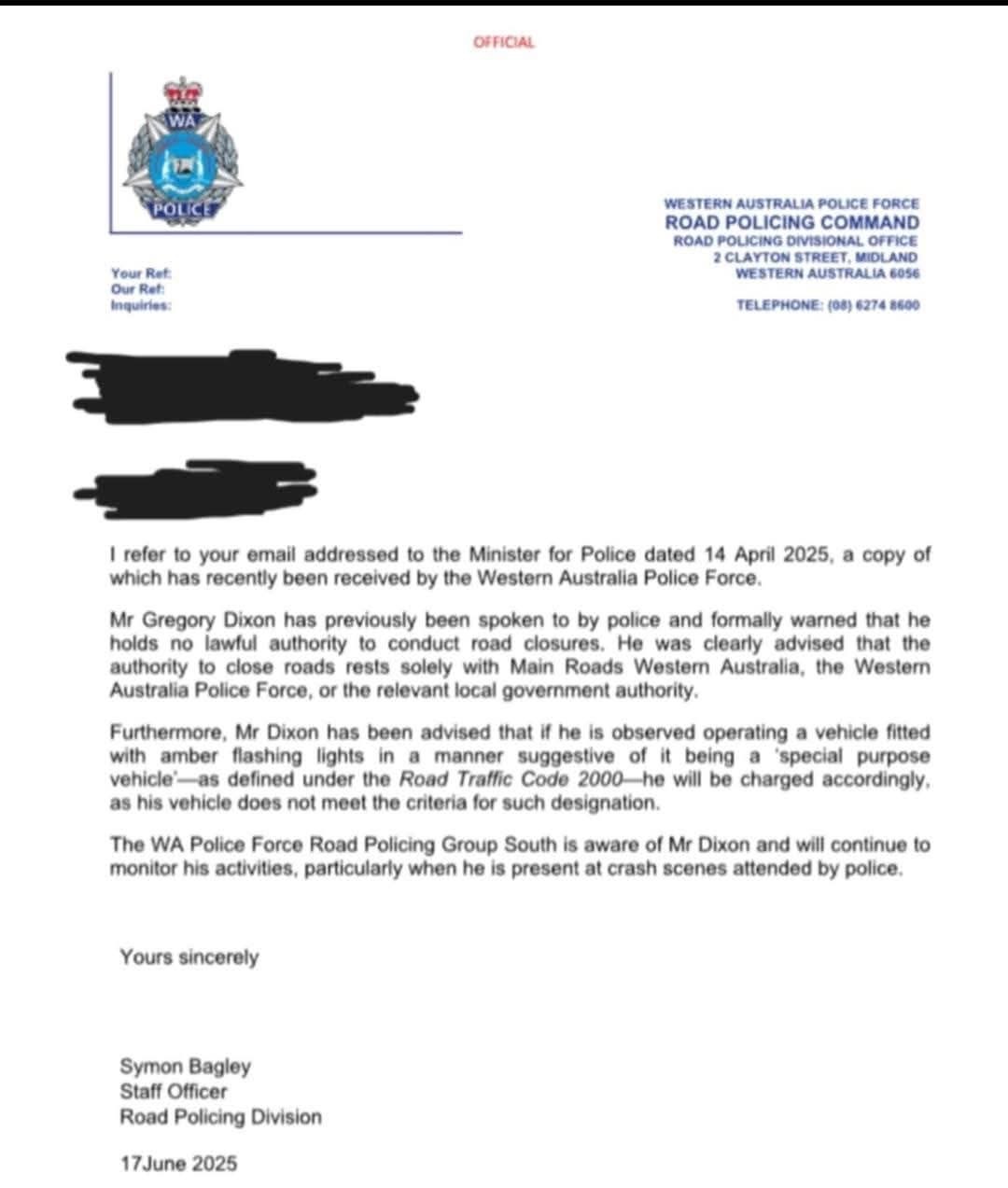
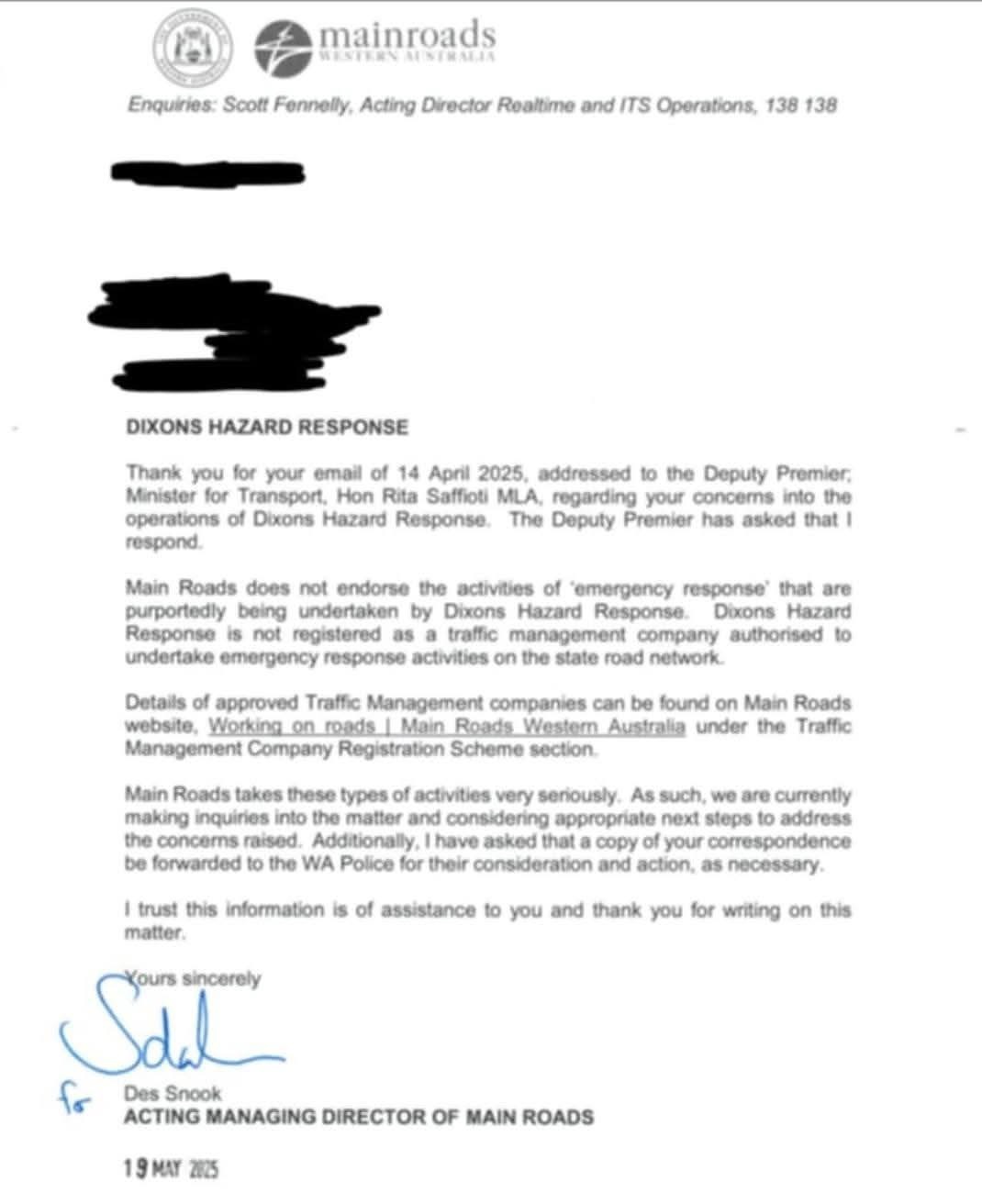
There are some questions about the authenticity of these letters particularly as the letter from the police is not signed and I would not think it is usual for police to provide that sort of detailed information about someone else and their investigation in response to a letter from a third party. But I don’t know who they were addressed to and for the sake of the argument I will assume that they are genuine. I also assume that this letter, that appears on Dixon’s Facebook page is also genuine.
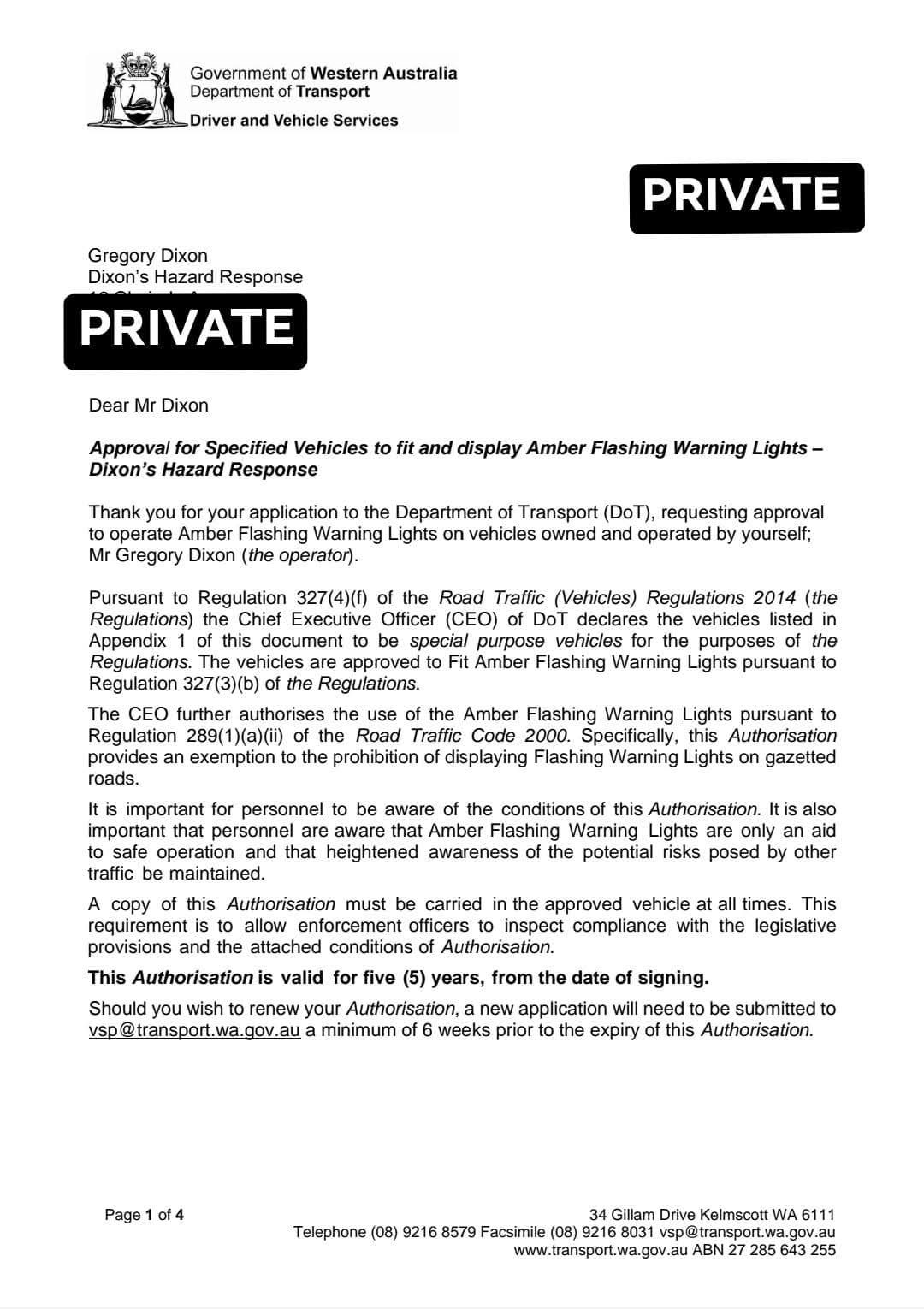
My view, back in 2022 was that I could not see that Dixon’s were breaking any laws. That is still my view.
The police letter
The letter from police says that Dixon’s vehicle, fitted with yellow flashing lights, does not meet the criteria of a ‘special purpose vehicle’. A special purpose vehicle is defined in the Road Traffic Code 2000(WA) as, amongst other things, ‘a vehicle duly authorised as a special purpose vehicle for the purposes of these regulations, by the CEO’.
The letter from the Department of Transport says that Dixon’s vehicle is a special purpose vehicle for the purposes of the Road Traffic(Vehicles) Regulation 2014(WA). That appears to be a misnomer, for the purposes of r 327(3)(b) the vehicle should be described as a ‘special use’ vehicle. A special use vehicle includes ‘any other type of vehicle approved by the CEO and used in conformity with any conditions that may be imposed by the CEO’(r 327(4)). Although it is unfortunate that the letter refers to a ‘special purpose’ rather than ‘special use’ vehicle I would suggest if it came to the test it would be accepted that this was a typographical error and the CEO was intending to give approval as a ‘special use’ vehicle under the regulation cited in the letter.
In any event the letter also refers to approval under r 289(1)(a)(ii) of the Road Traffic Code 2000(WA). That regulation says:
(1) Regulation 193(prohibiting the use, on a vehicle, of a light displaying intermittent flashes) does not extend to —
(a) the use of a light displaying intermittent flashes of a colour or colours approved by the CEO, upon — …
(ii) any other type of vehicle approved by the CEO and used in conformity with any conditions that may be imposed by the CEO;
Dixon’s vehicle may not be a special purpose vehicle for the purposes of the Road Rules 2000(WA) but it doesn’t need to be as there is permission to be fitted with yellow lights and to use those lights in accordance with the conditions set by the CEO.
As for the statement that Dixon’s has ‘no lawful authority to conduct road closures’ that may be true, but so what? At least as reported on Dixon’s Facebook page they do not close roads. Look at this photo from the Dixon’s Facebook page where the Dixon’s vehicle is parked in what is described as the ‘fend off’ position.

Dixon’s has parked the vehicle and set out cones because of the vehicle that is broken down in the front of the picture. Dixon’s is not closing the road, the road is closed because of the broken down vehicle. Take the Dixon’s ute and cones out of the picture and still no-one can travel in that lane.
Imagine waiting at traffic lights and the lights turn green but the vehicle in front doesn’t move off because of a mechanical failure. The driver in the car behind puts on their hazard lights and gets out to approach the driver in front to see if they can help. It would be fanciful to say that this driver has ‘closed’ the road because their car is parked with its hazard lights on. Equally it would be fanciful to say that anyone was committing an offence if a number of good Samaritans held up the traffic in other lanes whilst they pushed the broken down car off the road.
It may be argued that the Dixon’s vehicle is illegally parked, as is the vehicle that sits behind the broken down vehicle, even more so if the broken down vehicle is pushed off the road and before the driver of the second vehicle can get back to move it. That is provided for in the Road Rules. Rule 138, which is in Part 12 ‘Restrictions on stopping and parking’, says:
It is a defence to the prosecution of a driver for an offence against a provision of this Part, or against a regulation that refers to this regulation, if —
(a) the driver stops at a particular place, or in a particular way, to avoid a collision, and the driver stops for no longer than is necessary to avoid the collision; or
(b) …
(c) the driver stops at a particular place, or in a particular way, because the driver or a passenger is assisting with a disabled vehicle, and the driver stops for no longer than is necessary for the disabled vehicle to be moved safely to a place where the driver of the disabled vehicle is permitted to park that vehicle under these regulations; or
(d) the driver stops at a particular place, or in a particular way, to deal with a medical or other emergency, and the driver stops for no longer than is necessary in the circumstances; …
Conclusion
What the police letter says may be true that is Dixon’s vehicle is not a special purpose vehicle as defined by the Road Rules 2000 (WA) and Dixon’s does not have authority to conduct road closures. If my analysis is correct, that’s all true but irrelevant. The permission to fit and use yellow flashing lights is granted by the CEO and he’s not closing roads, he’s warning others that the lane is closed.
The main roads letter
The letter from Main Roads says that they do not endorse Dixon’s activities, but so what? The general rule of thumb is that a citizen can do whatever they like unless there is a law that says they cannot. Main Roads my not endorse the work that Dixon’s does but there endorsement is not required. The letter does not say that Dixon’s is breaking any law or that they are taking legal action to enforce any legal prohibition.
Conclusion
The burden on anyone alleging a breach of the law is to identify the law that is being breached. There are thousands of laws, and it is not possible to look at every law to see whether each one is or is not being breached. In the absence of a specific allegation, I cannot see any law that Dixon’s are breaking nor does the letter from Main Roads allege any breach of the law.
Causing an accident
Another issue that arises on Dixon’s Facebook page is some suggestion that Dixon’s will be liable if a vehicle runs into the Dixon’s ute when it is being used to protect other drivers. The general rule will always be that anyone who runs into a stationary vehicle is prima facie at fault whether that vehicle is supposed to be there or not. Drivers always have to be on the lookout for unexpected hazards which can include vehicles or people stopped on the roadway and drivers always have the option of stopping. If the Dixon’s ute is parked as shown in the photo above and someone runs into it, that driver would be at fault.
Conclusion
In my first post, written in 2022 I said:
It is a truism in emergency management that ‘first responders are always local’. The first responders at a car accident are the other drivers, at a building collapse it’s the neighbours, at a cardiac arrest its the bystander who can start CPR. The emergency services are (nearly) always second on scene.
In that sense this person is being an active citizen. Agencies like the SES are built on that idea. Members of the community volunteer to provide services to their community. Sure they are trained and uniformed but the fundamental principle is that members of a community form together to help their community. This person’s actions are not significantly different save that he is acting on his own.
I also said:
… based on what’s reported on the website, apart from the possibility that the fitting of yellow light bar to the car may be illegal, I cannot see that providing any of the services listed is unlawful or requires particular authority.
The only change in my opinion is the letter from the Department of Transport granting approval to fit and use yellow lights clarifies that the ‘fitting of yellow light bar to the car’ is approved and therefore not illegal. Nothing that I have seen since, including the letters reproduced here from WA Police and WA Main Roads change the other opinions expressed in that post.
This blog is a general discussion of legal principles only. It is not legal advice. Do not rely on the information here to make decisions regarding your legal position or to make decisions that affect your legal rights or responsibilities. For advice on your particular circumstances always consult an admitted legal practitioner in your state or territory.


Further to this post I received the following by email:
“Hey Mate
Further update/screen shot from main roads not the greatest image but I have scripted it under.
“Thank you for your recent correspondence, regarding the operations of Dixons Hazard Response, Main Roads apologises for the delay in responding to you.
Main roads can confirm that the safety concerns you have raised were formally refereed to the West Australian Police on 20 February 2025 following receipt of a similar request, and WA Police acknowledged receipt of the referral, how ever as the the matter is now with WA Police Main Roads is not able to provide case-specific details such as contacts or reference numbers, any follow-up enquiries regarding the issues should be directed to WA Police.
Main Roads notes that the regulation of flashing lights under the Road Traffic Act 1974 (WA) sits with the Department of Transport and Major Infrastructure.
In addition to the referral please be advised that Main Roads recently issued a formal cease and Desist notice to Dixon’s Hazard Response, this correspondence reiterates that Main Roads does not authorise or endorse the emergency response activities being carried out by Dixon’s Hazard Response on highways or main roads under the commissioner’s care and control.
Main Roads appreciates you raising this matter with us and can assure you it is being taken seriously. At the same time, we are exploring additional initiatives to enhance the safety of road users and first responders.
Main Roads trusts this information is of assistance and thanks you for writing on this matter.”
I have good confirmation with some of my contacts within/around RNOC (main roads) that Dixson has in fact been told to stop although he denies this via is latest Facebook post:
How ever through my contacts I can confirm the below:
“If he is found on the road operating under Doxon hazard response. He will lose his BWTM/TC ticket and will suffer the same consequences as a PCBU (Person conducting business undertaking)
He is not a registered traffic management business. So its illegal for him to be doing traffic management without registration and full insurance”
Please update when you can.”
I have several issues with this email and the information it contains. First the statement at the end ‘Please update when you can’ comes across as a direction rather than a request; but I’ll ignore that.
Second I have no idea why people are so keen to find that Dixons Hazard Response is doing something illegal.
Next I’m told the quoted text is from a ‘screen shot from main roads’ which I have been provided but not put here. I infer that it is an answer to an email that my correspondent sent to Main Roads. The screen shot is signed off as ‘Customer Service – Network Operations Directorate’, not from Main Roads legal branch. The text doesn’t say anything significantly different to the material referred to in the post above, so it doesn’t change my answers.
A simple rule of thumb is that a person can do whatever they like unless there is a law that says they cannot. Government’s on the other hand can only do what the law permits them to do. A government agency can only write a ‘cease and desist letter’ or more accurately, direct someone to stop doing something, if there is a law that gives them that power. The quoted text says ‘this correspondence reiterates that Main Roads does not authorise or endorse the emergency response activities being carried out by Dixon’s Hazard Response’; but so what. I don’t endorse what he does either but that’s not going to stop him as he doesn’t need my endorsement. And if I wrote to him telling him to cease and desist he would rightly point out I have no authority to direct him to do, or not do, anything. If main roads claim some authority to give such a direction, they would need to identify where that power comes from.
As for information from your contacts, I doubt they are lawyers. First advice that he ‘will suffer the same consequences as a PCBU (Person conducting business undertaking)’ is meaningless unless there are identified consequences for a PCBU. I might infer that the assertion if he is breaching the Work Health and Safety Act 2020 (WA) (the ‘WHS Act’) then he would suffer the consequences that might befall any other PCBU, but that’s a long step. The critical question is whether he is even bound by the WHS Act. A volunteer association is not a PCBU (s 5(7)). A volunteer association is ‘a group of volunteers working together for 1 or more community purposes where none of the volunteers, whether alone or jointly with any other volunteers, employs any person to carry out work for the volunteer association’. I understand Dixon’s Hazard Response does not employ anyone, including Mr Dixon.
Assuming he is bound by the WHS Act, Main Roads WA is not the relevant regulator, WorkSafe WA is so it would be WorkSafe, not my correspondent’s contacts, who would have to decide whether they think the Act applies, if there has been any alleged breach and what if any steps they want to take.
As for ‘He is not a registered traffic management business. So it’s illegal for him to be doing traffic management without registration and full insurance’ appears to misunderstand what he says he does. Again in a criminal context, anyone who wants to allege a breach of the law has to identify the law that they say applies. Prosecutors do not say ‘that was illegal’ and then leave it up to the defendant to work out what law they think the prosecutor is referring to. The prosecutor needs to allege a breach of section 123 of XYZ Act. I may claim to be an expert on the law of the emergency services, but I am not an expert on every section of every Act and Regulation in WA so if someone says what he’s doing is illegal, and they want me to comment, they need to say why they think it’s illegal.
But a web search does turn up this page ‘Working on Roads’ https://www.mainroads.wa.gov.au/technical-commercial/working-on-roads/. This page from Main Roads WA does talk about the Traffic Management Company Registration Scheme but that applies for companies that are implementing traffic management for works or events. The Traffic Management for Works on Roads Code of Practice (May 2025) (https://www.mainroads.wa.gov.au/49c3e0/globalassets/technical-commercial/working-on-roads/traffic-management/traffic-management-for-works-on-roads-code-of-practice.pdf) says it governs ‘managing traffic at work sites on roads’. My understanding is that is not what Dixon is doing. He’s providing some assistance where a vehicle has broken down on a road. The Main Roads WA Frequently Asked Questions Changes to the State Road Traffic Management Company Registration Scheme (November 2025) (https://www.mainroads.wa.gov.au/4abd73/globalassets/technical-commercial/working-on-roads/traffic-management/traffic-management-registration-scheme-faq.pdf) says:
“A non-registered traffic management company (including local government) can implement traffic management on the State Road network in an emergency situation. In an emergency, safety is the priority. For example, if there is a burst water main in a rural area, the situation can be handled by the closest company to ensure public safety. Also, the emergency services are exempt from this Scheme as they are not considered to be traffic management companies.”
There is a list of registered traffic management companies (https://www.mainroads.wa.gov.au/globalassets/technical-commercial/working-on-roads/traffic-management/list-of-registered-traffic-management-companies.pdf?v=4a49bf). In the context of this discussion, a notable absence from that list is the Royal Auto Club of WA (Inc) a company that, like Dixon, provides roadside assistance at breakdowns. Nor can I find any special exemptions for the RAC under the West Australian traffic laws. But they, like anyone, can stop to assist a person in need by the side of the road.
My update is therefore that some people really want to find that Dixon is breaking a law but without specific reference to a specific section of an Act I cannot see that he is. It appears to be a misunderstanding of what he is doing and given he is not (or at least does not claim) be doing traffic management at planned events or road work, he is not acting as a traffic management organisation any more than someone is who stops to provide assistance at an accident.
It is not illegal to be doing traffic management at an emergency and as I’ve noted, anyone can direct traffic around an emergency. Other drivers may not be required to obey those directions but if you go back past a blind corner and wave down drivers to warn them of an accident ahead, or even use your car to block a road whilst others provide assistance, there is no offence.
A reminder that this is not the place for legal advice and the outcome to any legal question depends on the facts. The only facts I have are what I see on Dixon’s website. If Main Roads can prove he’s doing something other than what he says then the outcome may be different. And I don’t know all the details of his operations so Dixon would not want to take what is written here as legal advice. But one might think if Main Roads or WA Police could identify a law he is breaking they would have done something about it by now.
As far as I can see, and subject to my limited access to the facts, Dixon’s Hazard Response is not breaking any laws.
Hi,
From what I have researched, G.Dixon’s vehicles received approval to have amber/yellow beacons attached as he has registered as a business providing motor break-down services and is a roadside assistance provider.
DHR regularly attends crashes and incidents on main roads/freeways where there is often attendance by either WAPOL, Authorised Tow trucks or other Emergency Services attending, where he then sets his vehicle up as a barrier (with flashing beacons) and high-vis cones and acts in place of traffic management.
According to the Road Traffic Code 2000:
137A. Approaching and passing stationary incident response vehicles.
(1) In this regulation —
hazard warning light has the same meaning as in regulation 188;
incident response vehicle means any of the following vehicles if the vehicle is displaying a flashing light other than a turn indicator light or hazard warning light —
(a) an emergency vehicle;
(b) a motor break-down service vehicle;
(c) a tow truck;
(d) a vehicle that is being used to provide an incident response service on behalf of the Commissioner of Main Roads.
So a motor break-down service is classified as an incident response vehicle, however:
288A. Exemption for motor break-down service vehicles, a motor break-down service is not a tow truck (this is relevant to another Act I will mention below) the exemption stems from the permission issued by the CEO of DoT to have the flashing beacons as a motor break-down service in accordance with:
(2) A provision set out in the Table to this regulation does not apply to the driver of a motor break-down service vehicle if —
(a) the driver is engaged in repairing a disabled vehicle or is assisting a person to gain access to a vehicle in which the person has locked the vehicle access key; and
(b) it is not practicable for the driver to comply with the provision; and
(c) the motor break-down service vehicle is displaying a yellow flashing light; and
(d) the driver is acting safely.
Table
* regulation 119 (Driving on median strips, painted islands, etc.)
* regulation 127 (Moving from one marked lane to another marked lane across a continuous line separating the lanes)
* regulation 254 (Driving on a nature strip)
A motor break-down service/roadside assistance provider isnt defined as attending crashes or a crash site, those terms are defined in the Towing Services Act 2024..
Under the Towing Services Act 2024 (WA) Section 3:
crash site means a place —
(a) where a vehicle that has been involved in a vehicle crash is present; and
(b) that is a place referred to in section 6(2)(a), (b), (c) or (d) of the Act.
restricted name or logo means the name or logo of an entity that —
(a) is a public entity; or
(b) is an insurance company; or
(c) is a roadside assistance provider; or
(d) provides a vehicle repair service or vehicle hire service;
roadside assistance provider means an entity that provides repair or maintenance services to broken down vehicles at the site of the breakdown
So, according to the above, when DHR attends a crash/crash site would this not then render DHR’s permission to use the specified vehicles amber/yellow beacons unlawful?
Wont this also mean that DHR wouldn’t lawfully be allowed to setup their vehicle in the “fend off” position along with the high-vis cones because DHR isnt “attending” under the registered role as a roadside assistance?
If DHR is attending a vehicle that has legitimately broken down then there are protections in the relevant Act’s, Code’s and Regulation’s to operate under however, those change when on the Freeway.
G.Dixon often cites Regulation 138 of the Road Traffic Code 2000 for his ability to block traffic with his vehicle set up in the “fend off” position along with cones and Flashing Beacons, but this doesnt provide the ability to block traffic its only a defence to getting prosecuted for stopping/parking temporarily in an area not allowed to render assistance “for no longer than is necessary for the disabled vehicle to be moved safely to a place where the driver of the disabled vehicle is permitted to park that vehicle”, once he sets up cones and his vehicle, this then becomes an obstruction, not temporary assistance.
You say:
“From what I have researched, G.Dixon’s vehicles received approval to have amber/yellow beacons attached as he has registered as a business providing motor break-down services and is a roadside assistance provider.”
The Road Traffic Code 2000 (WA) r 3 defines a ‘special purpose vehicle’ as:
“(a) a vehicle being driven by a police officer on official duty or that vehicle when it is stationary at any place connected with the official duty; or
(b) a public utility service truck; or
(c) a tow truck; or
(d) a motor break down service vehicle; or
(e) a vehicle being used by a State government agency or local government in connection with its roadwork or speed zoning functions; or
(f) a vehicle duly authorised as a special purpose vehicle for the purposes of these regulations, by the CEO,
but does not include an emergency vehicle;”
If Dixon is providing a ‘motor-break down service’ he does not need the Department’s specific approval because his vehicle would be a special purpose vehicle by virtue of paragraph (d), above. He got permission, presumably, because he does not fall within paragraphs (a) to (e) above. His is a special purpose vehicle by virtue of paragraph (f).
If that’s correct his is not an ‘incident response vehicle’ as defined by r 137A which you have quoted above. That means there is no offence for failing to slow down when passing his vehicle (r 137A(2), (3) and (4)). It also follows that the exemptions set out in r 288A also don’t apply, so he is not permitted to drive on ‘median strips, painted islands etc’, move ‘from one marked lane to another marked lane across a continuous line separating the lanes’ or drive ‘on a nature strip’.
The term ‘crash site’ is defined in the Towing Services Regulations 2025 (WA); not the Act. It does say that a crash site is:
a place —
(a) where a vehicle that has been involved in a vehicle crash is present; and
(b) that is a place referred to in section 6(2)(a), (b), (c) or (d) of the Act;
Section 6(2) of the Act says that the crash site includes
(a) the place where the collision or impact occurred; or
(b) a place within a 2 km radius of the place where the collision or impact occurred; or
(c) a place to which the vehicle has been moved —
(i) by or with the authority of a public entity or a person employed in, or engaged for the purposes of, a public entity; and
(ii) for the purpose of preventing or minimising any harm, risk, hazard or obstruction caused by the vehicle;
or
(d) a place within a 2 km radius of a place referred to in paragraph (c).
You say “A motor break-down service/roadside assistance provider isn’t defined as attending crashes or a crash site” but that doesn’t make sense. If a motor-break down service is at one of those places listed above it’s at a crash site and they may well be. Someone may have rung them they may have just come across the accident. The Towing Service Act may be about who can tow vehicles from a crash site but says nothing about who may be at a crash site.
I don’t know why you’ve quoted the definition of ‘restricted name or logo’. That term is relevant in that tow truck operators are not allowed to display a restricted name or logo when touting for business (rr 9 and 44). So a tow truck operator cannot have AN RAC WA logo on their tow truck. But what’s that got to do with Dixon?
None of the material you’ve cited leads to the conclusion you are arguing for. The Tow Truck Act and its Regulations are irrelevant. They don’t stop a roadside assistance provider like RAC WA stopping at an accident and activating their amber lights if that was required to make the scene safe. In any even DHR has permission to fit amber lights because his vehicle is a special purpose vehicle because the Commissioner says it is, not because he is providing a road side break down service.
You say:
“G.Dixon often cites Regulation 138 of the Road Traffic Code 2000 for his ability to block traffic with his vehicle set up in the “fend off” position along with cones and Flashing Beacons, but this doesn’t provide the ability to block traffic it’s only a defence to getting prosecuted for stopping/parking temporarily in an area not allowed to render assistance “for no longer than is necessary for the disabled vehicle to be moved safely to a place where the driver of the disabled vehicle is permitted to park that vehicle”, once he sets up cones and his vehicle, this then becomes an obstruction, not temporary assistance.”
I don’t understand the logic. If he’s stopped ‘at a particular place, or in a particular way’ to assist a vehicle then r 138 says he’s not committing an offence, even if he’s blocking traffic so of course the regulation provides an ability to ‘block traffic’. I’ve otherwise addressed r 138 in my post, above and nothing you have put here causes me to change my opinion.
Community services have always developed because people see a need and start doing what they see as useful – think Surf Aid, Blaze Aid, the Country Fire Authority, etc. Dixon is continuing a long tradition of seeing a need and stepping up to fill it. I still cannot see that he is breaking any laws. If he was then I’m sure WAPOL would be onto it, he’s not hard to find and, as you say, he often attends incidents where WAPOL are there. If WAPOL haven’t prosecuted him I think you can infer that they haven’t identified any offences being committed.
I personally find it hilarious that Main Road put a statement about the guy on their website. Seems petty for a government agency to do that.