
Today’s correspondent says:
I’m in the NSW SES, our local LGA recently experienced a heavy rainfall event (just like other LGA’s) during which sandbags were made available. Our records show that 1 person picked up 2.5 tonnes of bags. My question is, IF the SES overload a car trailer, can we be held liable if the vehicle is fined by the police, or is involved in an accident, akin to the Heavy Vehicle Chain of Responsibility laws?
The best answer I can give is ‘possibly’. With respect to criminal responsibility (ie fines) the obligation to ensure a vehicle and trailer combination is not overloaded rests with the driver. There would be no liability if the driver was fined.
If the vehicle is involved in a collision where it can be shown that the overweight trailer contributed to the accident then it could, in the right circumstances, be arguable. Let us assume that the trailer was overweight and as a result the vehicles insurer avoids any claim. The owner/driver left without recompense from their insurer looks to the SES arguing that the SES was negligent in allowing the trailer to be overloaded and to leave their location in a dangerous condition.
In Caltex Refineries v Stavar (2009) 75 NSWLR 649, Allsop P said that when determining whether a duty of care would exist in ‘novel’ situations it was necessary to consider all the salient features of the relationship between the plaintiff (in this case the owner/driver) and the defendant (the SES). He said (at [103])
These salient features include:
(a) the foreseeability of harm;
(b) the nature of the harm alleged;
(c) the degree and nature of control able to be exercised by the defendant to avoid harm;
(d) the degree of vulnerability of the plaintiff to harm from the defendant’s conduct, including the capacity and reasonable expectation of a plaintiff to take steps to protect itself;
(e) the degree of reliance by the plaintiff upon the defendant;
(f) any assumption of responsibility by the defendant;
(g) the proximity or nearness in a physical, temporal or relational sense of the plaintiff to the defendant;
(h) the existence or otherwise of a category of relationship between the defendant and the plaintiff or a person closely connected with the plaintiff;
(i) the nature of the activity undertaken by the defendant;
(j) the nature or the degree of the hazard or danger liable to be caused by the defendant’s conduct or the activity or substance controlled by the defendant;
(k) knowledge (either actual or constructive) by the defendant that the conduct will cause harm to the plaintiff;
(l) any potential indeterminacy of liability;
(m) the nature and consequences of any action that can be taken to avoid the harm to the plaintiff;
(n) the extent of imposition on the autonomy or freedom of individuals, including the right to pursue one’s own interests;
(o) the existence of conflicting duties arising from other principles of law or statute;
(p) consistency with the terms, scope and purpose of any statute relevant to the existence of a duty; and
(q) the desirability of, and in some circumstances, need for conformance and coherence in the structure and fabric of the common law.
The answers to those questions will vary on a case-by-case basis. The SES cannot be expected to know the towing capacity of every vehicle or the load capacity of every trailer. But sometimes it will be obvious that a trailer is overloaded so sometimes the risk of harm will be clearly foreseeable, in others it may be no more than a theoretical possibility (that trailer is clearly and dangerously overloaded v if the trailer is overloaded that would be dangerous but I have no way of knowing if this trailer is in fact overloaded).
Who has control over the risk? That is does the person collect sandbags and put them in their trailer or do SES members load the trailer? If the former, then it is the owner/driver who is exercising relevant control. Further the SES does not have the power to direct a person not to overload their trailer nor the power to stop them driving away if the vehicle is overloaded.
Some owner/drivers may be clearly ignorant about trailer loading, and therefore more vulnerable and more reliant on the advice of others. Others may be, or at least may appear to be, quite knowledgeable about what they are doing and therefore not vulnerable nor reliant on the advice of others.
The SES by issuing sandbags particularly if it’s ‘as many as you want’ is not in any way holding out that they are taking responsibility for assessing the capacity of the owner/driver’s vehicle to carry them.
The relationship is not a commercial relationship and wouldn’t have the pressures that the heavy vehicle industry faces and which led to the legislation of the chain of responsibility. The person is not being asked to deliver the sandbags on behalf of the SES to another location as a matter of urgency and therefore under pressure from the SES to overload the trailer. They are collecting sandbags for their own use so any time pressure is being imposed by themselves or by the circumstances of the hazard which are outside everyone’s control.
So could there be liability? I imagine in the right circumstances there could be – imagine a person arrives to collect sandbags, they’re clearly very anxious almost to the state of panic, they say they have borrowed a mates car and trailer but have never towed a trailer before, they have loaded the trailer with sandbags and ask for more even though the load will now be taller than the cage on the trailer and the trailer is clearly incorrectly loaded (as shown below with reference to caravans – source John Ford, ‘Understanding Caravan Weights’ (2023) 631 Caravan World pp. 48-59 at 59):
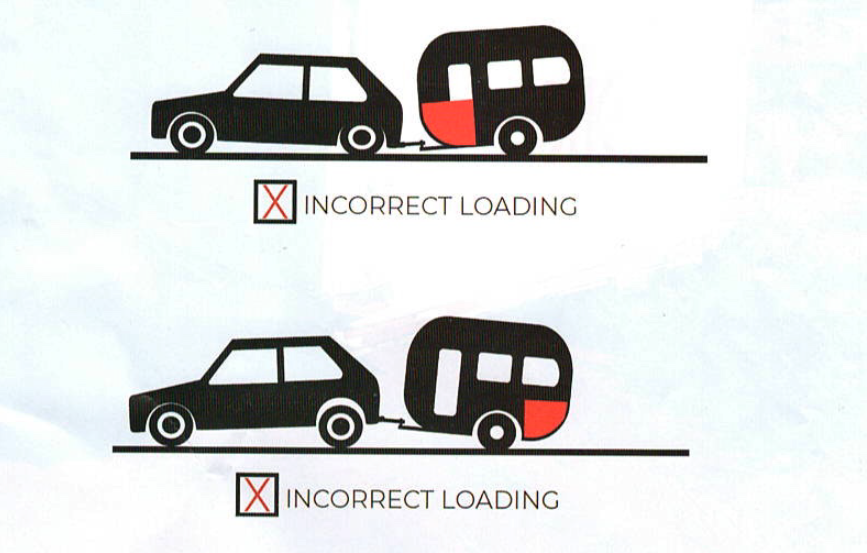
And the person says to the SES member (who is very experienced with towing trailers) ‘do you think this will be ok to get home?’ and the reply is ‘it’ll be fine, just take it easy’.
In those circumstances I would suggest you have a person who is clearly vulnerable to the risk that comes with driving an overloaded trailer, indicating that they are seeking to rely on the advice that they are being given, and there has been some assumption of responsibility by the SES. If that vehicle is involved in a collision or roll-over because of the unsafe loading of the trailer there would have to be an arguable case of negligence.
Compare that to a person who turns up, approaches the SES and is assigned a certain number of bags, loads them on to their own trailer without engaging with the SES members other than to thank them for the, and their, service. Drives off with a trailer that looks stable, but which is in fact over its load limits or the towing capacity of the car given the other items already loaded in the vehicle. There could be no liability in that case. Between those two extremes all sorts of situations can be imagined.
No doubt the SES would argue that it did not owe a relevant duty of care. All it did was make sandbags available. The SES could not know the towing limits of every possible car and trailer combination and the law is clear that the obligation to ensure the vehicle meets its limits rests with the driver (Road Transport (General) Regulation 2021(NSW) r 52 ‘Use of vehicle in contravention of dimension, mass or load requirements’ and r 67 ‘Driver to have sufficient control’)
Interestingly the Road Transport (General) Regulation 2021 (NSW) r 66 ‘Load requirements’ says:
(1) A load on a vehicle or a trailer must not be placed in a way making the vehicle unstable or unsafe.
(2) …
(3) An appropriate method must be used to restrain the load on a vehicle.
(4) In proceedings for a contravention of a requirement under this section, it is sufficient for the prosecution to prove the load on the vehicle was not placed, secured or restrained in a way meeting the performance standards recommended in the Load Restraint Guide.
That regulation does not refer to the driver. If the SES are loading the trailer on behalf of a stakeholder then arguably, they are responsible for ensuring that the load is not ‘placed in a way making the vehicle unstable or unsafe’ and that an ‘appropriate method must be used to restrain the load on a vehicle’. Given the SES is not in control of what methods of restraint the driver has, and the SES members may not be familiar with the Load Restraint Guide, it would appear obvious that the SES members should not be loading the trailer but rather leave that to the owner/driver who has to take responsibility for his or her own load.
The heavy vehicle chain of responsibility
The sort of liability discussed above is not ‘akin’ to the heavy vehicle chain of responsibility. That scheme is put in legislation because the common law clearly did not, or at least was perceived not to, adequately deal with the matter. Where we’re talking about light vehicles (cars and trailers) then the heavy vehicle legislation will not apply.
The heavy vehicle chain of responsibility imposes duties on many stakeholders and creates specific criminal offences for failing to comply with those duties (see Heavy Vehicle National Law (NSW) Chapter 1A). These provisions cannot apply here and as noted it is the driver who will be liable for any fines relating to an overloaded vehicle. Accordingly, my argument, above, is that there could be common law liability, not liability that is ‘akin to the Heavy Vehicle Chain of Responsibility laws’.
Work Health and Safety
Like the Heavy Vehicle National Law, the Work Health and Safety Act 2011 (NSW) imposes duties on multiple stakeholders. One such duty is a duty on the PCBU (in this case the SES) to (s 19(2)):
… ensure, so far as is reasonably practicable, that the health and safety of other persons is not put at risk from work carried out as part of the conduct of the business or undertaking.
But what is the ‘work’ of the SES? Here they are supplying sandbags. They are not directing people to use them, they are not requiring people to use them, if they are not loading the trailer they are not taking responsibility for ensuring it is lawfully or safely loaded, they have no control over what the person taking the bags may or may not do with them. Just as the SES would not be required to ensure that they provided a driver to safely drive the person home, or put them through a towing test, so to the SES cannot be responsible to ensure people meet their own obligations to drive lawfully and safely.
Conclusion
I can imagine that in the right circumstance, a clearly vulnerable person who is relying on the SES for advice and direct, could argue that the SES should be liable if they drove off with an obviously dangerously overloaded trailer and then had a collision. Counter to that is that the SES is not in control of the risk and that coherence in the law requires that it is the driver who is responsible for ensuring that their vehicle combination is safely loaded and that they are competent to determine that and to drive the vehicle they are taking command of. So the matter could be argued but the outcome would not be a ‘lay down misère’ ie a certainty.
Without meaning to give legal advice to the SES and without knowing how these distribution points work, my thoughts are that
- The SES should not load people’s trailers; let them do that themselves.
- If asked about the load limits, advise people that it is up to them to know the load limits of their trailer and their car and it is their obligation to ensure that the vehicle combination is loaded within the weight limits.
- If the vehicle is obviously overloaded or loaded in a way that is dangerous, you don’t give any more sandbags.
This blog is a general discussion of legal principles only. It is not legal advice. Do not rely on the information here to make decisions regarding your legal position or to make decisions that affect your legal rights or responsibilities. For advice on your particular circumstances always consult an admitted legal practitioner in your state or territory.
 Australian Emergency Law
Michael, the short answer is, in relation to everything we do is, never assume a duty of care that doesn’t exist, by doing things that then create an obligation (Kirkland v Heemstra). If you don’t own the problem , then don’t become the owner of the problem by doing or saying things that create liability.
or even more bluntly, “No good deed goes unpunished”
.
Do you have a citation for ‘Kirkland v Heemstra’? I cannot find a case with that name. The closest name I can find (and the one all the search engines pointed me to) is Stuart v Kirkland-Veenstra [2009] HCA 15 but I don’t see that it stands for the proposition ‘never assume a duty of care that doesn’t exist, by doing things that then create an obligation’.