
A correspondent has sent me this story from the Sunday Mail which I infer is the weekend edition of the Courier Mail, a Brisbane paper but the story comes from NSW.

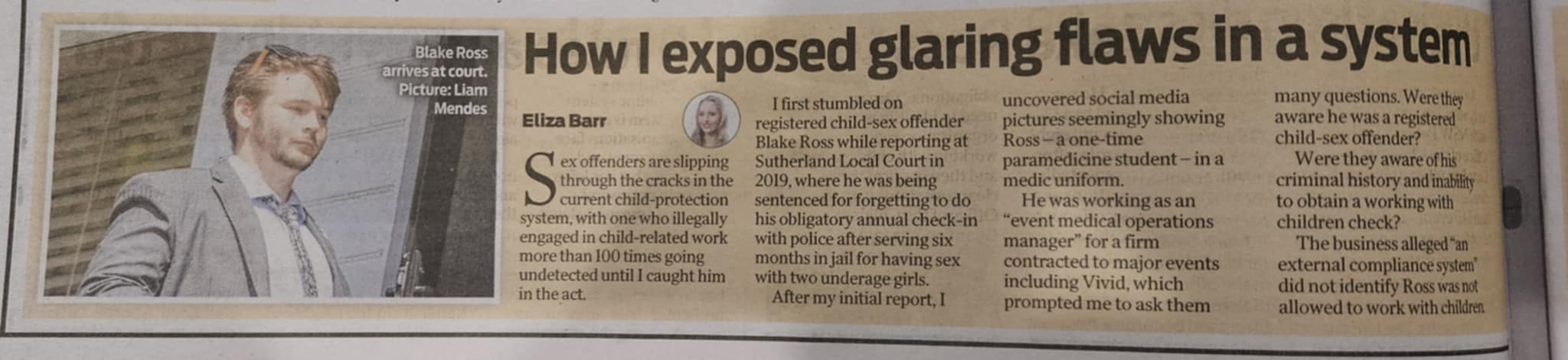

My correspondent says:
“Interesting (and very concerning) read. Makes one wonder if there is a role for compulsory WWCC for all student heath care registrants and if it’s time for a conversation re regulation of the event health space in jurisdictions other than vic?”
There is an argument to regulate the event health space for a number of reasons, but I’m not going to go there in detail. What I’ll do here is look at the relevant Working with Children laws in NSW.
Proactive or reactive
In NSW the relevant law is in the Child Protection (Working with Children) Act 2012 (NSW). That Act defines child related work as
(a) mentoring and counselling services for children,
(b) child protection services,
(c) the provision of health care in wards of hospitals where children are treated and the direct provision of other child health services,
(d) clubs, associations, movements, societies or other bodies (including bodies of a cultural, recreational or sporting nature) providing programs or services for children,
(e) respite care or other support services for children with a disability,
(f) education and care services, child care centres, nanny services and other child care,
(g) schools or other educational institutions (other than universities) and private coaching or tuition of children,
(h) sporting, cultural or other entertainment venues used primarily by children and entertainment services for children,
(i) detention centres (within the meaning of the Children (Detention Centres) Act 1987 ) and juvenile correctional centres (within the meaning of the Crimes (Administration of Sentences) Act 1999 ),
(j) any religious organisation,
(k) refuges used by children, long term home stays for children, boarding houses or other residential services for children and overnight camps for children,
(l) transport services especially for children, including school bus services and taxi services for children with a disability and supervision of school road crossings,
(m) any other service for children prescribed by the regulations.
Presumably event first aid services are covered by paragraphs (c) ‘the direct provision of other child health services’ and (d) ‘clubs, associations, movements, societies or other bodies … providing … services for children.
The Child Protection (Working with Children) Regulation 2013 (NSW) r 6(2) says ‘(2) Other work as a health practitioner providing child health services is child-related work’. For that regulation (r 6(5)) the term ‘health practitioner’ means (emphasis added):
(a) a registered health practitioner within the meaning of the Health Practitioner Regulation National Law (NSW), and
(b) any other individual who provides a health service.
A health service includes ‘ambulance services’ (r 6(5)). The term ‘ambulance services’ is not defined in the Act or its regulation, but the Health Services Act 1997 (NSW) defines ‘ambulance services’ as ‘services relating to the work of rendering first aid to, and the transport of, sick and injured persons’. There is no reason to think that that is not the definition that would be applied here.
It follows that a ‘medic’ (ie not a registered paramedic’) who is engaged to provide first aid to children is engaged in child-related work.
It is an offence for a worker to engage in child-related work without a working with children check clearance or if they are subject to an interim bar (Child Protection (Working with Children) Act 2012 (NSW) s 8). It is a defence if the person ‘did not know, at the time the offence was committed, that the work concerned was child-related work’ (s 8(3)).
An employer must not employ a person in child-related work if they know or have reasonable cause to believe that the worker does not hold a working with children check clearance or is subject to an interim bar (s 9). Further they must not employ the person unless they have confirmed and recorded their working with clearance check (s 9A).
In this case Mr Ross was obligated not to undertake child related work. His failure to meet that obligation led to his imprisonment for 12 months. The journalist, Eliza Barr says ‘This case is a disturbing example of how the system is reactive rather than proactive…’
I don’t agree. The system is clearly ‘proactive’. People are required to get their working with children clearance check before starting work and employers are obligated to check. That requires, to comply with the law, pro-active steps. Of course, the system doesn’t guarantee that everyone will obey the law, any more that it guarantees that someone with a working with children check won’t abuse children. A working with children check means there is no relevant past history that has been detected. Not that the person won’t offend in the future or in fact hasn’t offended in the past, but that past offending has not been detected. What this case does demonstrate is that the criminal law is, as it always is, reactive. That is the criminal law only gets involved once the crimes have been committed. The working with children check scheme is pro-active, but the criminal penalties only apply when someone fails to meet the pro-active obligations imposed by the scheme.
What is not clear is what further regulation would achieve. It may be true that parents cannot check a working with children clearance by name alone but it’s implausible to think that any parent would want to or could identify everyone who may come in contact with their child and then want to do a check on their work history. Think of an organisation like St John Ambulance, that deploys volunteers to an event. Before the event the various parents could not know who those volunteers are going to be and do a check. If you take your child to hospital you cannot know in advance who will be involved in the care of your children and do a check on every possible staff member. What else can we or anyone do but trust organisations to meet their legal obligations?
If one could check by name alone that would identify whether someone with a particular name had a clearance but would not confirm that it was ‘this’ person who had the clearance ie if you did a search for ‘John Smith’ and found a John Smith had a clearance, unless your search brought up a current photo, you could not know it was the ‘John Smith’ you are talking to.
One effective step might be to require everyone to display their working with children card as security guards have to wear their licences (Security Industry Act 1997 (NSW) s 36) and bus drivers display their public vehicle driving authority (Passenger Transport (General) Regulation 2017 (NSW) r 92). That won’t of course help where people have a card but they, unlawfully, continue to wear it if it has been cancelled or they are subject to an interim bar.
Another step may be to require courts to report to the regulator each time a person is charged with or convicted of a relevant offence. This would ensure that regulator does not depend on people self-reporting their criminal history. This would not however tell the regulator if someone was engaged in illegal child-related work. That would still require someone else to notice and report it.
Regulating event health services
As for regulating the event health service sector, what would it add here? I suppose it could mean that a company such as the one that employed Mr Ross could be banned from providing event health services to children if it failed to actually check his clearance status. We’re told however, that they relied on an external vetting process which failed to identify that he did not hold a current check, but we don’t know why that was or what the implications would be if the company were prosecuted for a breach of its obligations. As I see it, the real problem in this case, and which is not explored in this story, what steps the company took to meet its obligations and how or why the ‘… ‘external compliance system’ did not identify Ross was not allowed to work with children’. One cannot identify what the remedy to that problem is without knowing first what happened.
Requiring students to have a working with children check
As for a requirement for a working with children check for all ‘student health care registrants’, that would seem to make sense. I note that the Child Protection (Working with Children) Regulation 2013 (NSW) r 6(4) specifically says ‘Work as a student in the course of a student clinical placement in a hospital or other health service is not child-related work’. The reason behind that exemption is not clear. One might infer is the expectation that students will be continually monitored or that their fitness to be there is determined by others. Registered health practitioners are required to meet the registration standard on disclosing their criminal history but that too does not apply to students (see for example Paramedicine Board of Australia, Registration Standard: Criminal history (17 May 2018) which says (emphasis added): ‘This standard applies to all applicants for registration and all registered health practitioners. It does not apply to students.’
… enrolled in an approved program of study or undertaking clinical training must notify Ahpra through the local office within seven days of becoming aware that:
- they have been charged with an offence punishable by 12 months imprisonment or more or
- they have been convicted of, or are the subject of, a finding of guilt for an offence punishable by imprisonment or
- their registration under the law of another country that provides for the registration of students has been suspended or cancelled.
It is not clear if that would require them to disclose a conviction that was imposed prior to their enrolment as a student (see Relevant Tribunal cannot rule on matters prior to a paramedic’s registration (March 31, 2025)). Having said that it is not ‘clear’ my reading of the section is that it would apply to convictions both prior to and during their course of study. A student who had been convicted of an offence punishable by imprisonment should report that to AHPRA within seven days of being enrolled and that would allow the relevant board to take action that was considered in the public interest (Health Practitioner Regulation National Law s 156). But just as a person may seek to work without a working with children check, some may fail to make that disclosure.
If a student did not make a disclosure of a conviction incurred prior to enrolling they would need to disclose it when seeking registration. And AHPRA says ‘We conduct an Australian criminal history check on every applicant’. One could have hope that even if a practitioner was not honest in their criminal history disclosure it would be picked up with their application for registration.
Universities and health servcies say that they require a criminal history check prior to letting students go on placement (see for example Monash University, Flinders University and Western Sydney University) This certainly leaves it up to those institutions to ensure compliance.
Whether it’s AHPRA, the national board, the university, or the police, the system still requires (as all systems ultimately do) everyone to ‘cross their fingers and hope it is working appropriately’ and where it doesn’t (eg because systems sometimes fail or people lie) then there is a residual system in the criminal law to punish recalcitrants.
Conclusion
Mr Ross broke the law. Someone observed that, reported it to authorities, who took action. That is consistent with the criminal law generally and the system working as it is intended to work.
There is no legal system that guarantees that people won’t break the law. The working with children scheme is a pro-active scheme designed to identify people who should not be working with children. When it fails (either due to negligent or deliberate default) then the criminal law can apply. As with all criminal laws they only apply after the event. There is a pro-active system in place, but given 100% compliance can never be guaranteed there is a back up of the criminal law, but like all criminal laws, they can only apply after the event.
In this case Mr Ross broke the law, was caught and prosecuted. What is the real issue is why the employer did not check his working with children status but further regulation requiring them to do what they are already required to do won’t guarantee compliance. Whatever teh issues there is it not an issue for event health services or health services generally, it is an issue for all child related work.

Proudly supported by (in alphabetical order) the Australasian College of Paramedicine, the Australian Paramedics Association (NSW), the Australian Paramedics Association (Qld), Natural Hazards Research Australia, NSW Rural Fire Service Association and the NSW SES Volunteers Association. I am responsible for the content in this post including any errors or omissions. Any opinions expressed are mine, and do not necessarily reflect the opinion or understanding of these supporters.
This blog is a general discussion of legal principles only. It is not legal advice. Do not rely on the information here to make decisions regarding your legal position or to make decisions that affect your legal rights or responsibilities. For advice on your particular circumstances always consult an admitted legal practitioner in your state or territory.
 Australian Emergency Law
I was asked, via email:
“What is your view on the requirement for other emergency service workers to hold a working with children check in NSW?
As a specific example rescue operators of an accredited rescue unit who are required as part of their duties to go and rescue children (e.g. from a road crash rescue or flood rescue).
I note that the paid agencies (such as Police and Ambulance) already require WWCC as part of the regular course for their roles, but the volunteer agencies vary in their requirements to do so (often only using it for members involved in ComEd activities such as preschool visits or cadet programs).”
I don’t have a particular view. I have previously written on the ‘Blue Card’ requirements for Rural Fire brigades in Queensland (see https://australianemergencylaw.com/2019/07/20/working-with-children-check-for-qrfs-and-ses/). The critical issue in the NSW legislation is whether the work ‘involves direct contact by the worker with a child or children and that contact is a usual part of and more than incidental to the work’ and is the type of work listed in s 6(2) and detailed in the regulations.
As for rescue operators, the closest seems to be providing health services which includes ambulance services which in turn includes providing first aid but I think there is a distinction between a rescue operator providing first aid and a service like NSW Ambulance or even St John Ambulance. A rescuer operator who is providing first aid is providing that service in a way that is ‘incidental’ to their role as a rescue operator.
So I think just because you may find yourself giving first aid to a child as a rescue operator or firefighter that does not fall within the definition of child-related work. A risk averse agency may however take another view – getting your volunteers to get a WWC clearance is easy and if they don’t need it, no harm done. But if you don’t make them get one and they do need it, there is a world of pain to be negotiated. So the easy decision is to require everyone to have one.