
Today’s correspondent is
… a paramedic working in NSW and received this email (attached to the email) from a manager. My question is regarding patient privacy in the context of privacy laws in NSW. Does this sign hung on ambulance stretchers violate privacy?
I understand that complete privacy can be sometimes difficult to practically achieve in ED (particularly ambulance triage where we are packed in like sardines sometimes) but I wonder about openly displaying patient details like this. I’d be grateful for your opinion, as well as any advice on privacy in ED in general (ie are those thin blue curtains truly giving privacy if everyone can hear through them).
The email is shown below:
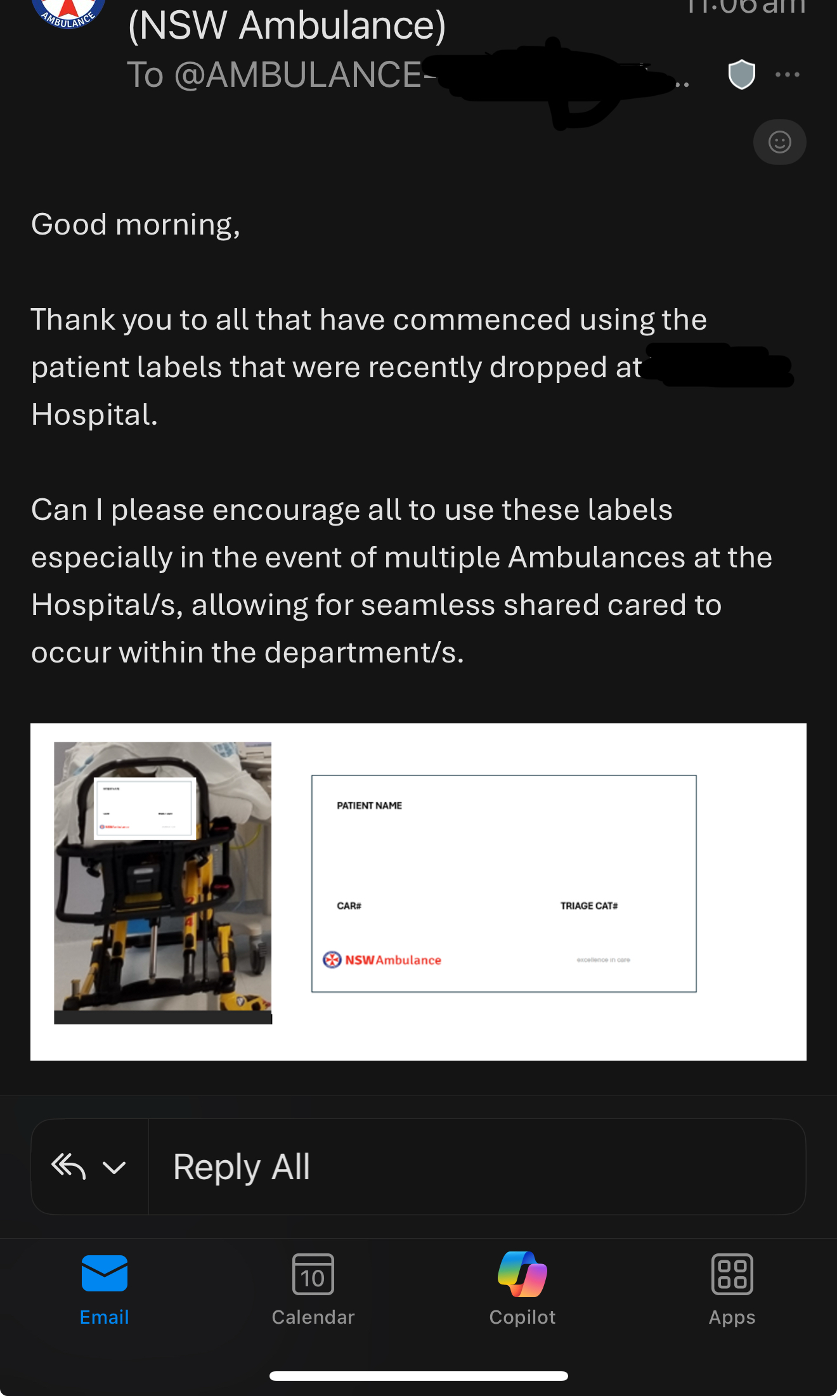
There are two relevant Acts, the Health Records and Information Privacy Act 2002 (NSW) and the Privacy and Personal Information Protection Act 1998 (NSW).
Personal information is ‘… information or an opinion … about an individual whose identity is apparent or can reasonably be ascertained from the information or opinion’ (Health Records and Information Privacy Act 2002 (NSW) s 5; Privacy and Personal Information Protection Act 1998 (NSW) s 4).
Health Information is (s 6(a)) personal information that is
… information or an opinion about–
(i) the physical or mental health or a disability (at any time) of an individual, or
(ii) an individual’s express wishes about the future provision of health services to him or her, or
(iii) a health service provided, or to be provided, to an individual
Health information is excluded from the definition of ‘personal information’ in Privacy and Personal Information Protection Act 1998 (NSW) (s 4A). It follows that if we’re talking about health information, the Health Records and Information Privacy Act is the relevant Act.
As far as I can see the sign has the patient’s name, car number and triage category. Their name and car number is neither personal nor health information. Their triage category might be as it represents information about an opinion of their condition (s 6(a)(i)).
The Health Privacy Principles talk about the collection and use of personal information. The issue here is the use of the information- ie not that a triage category is recorded, but that it is ‘used’ on this sign. Information must be used for the purpose for which it was obtained (Health Privacy Principle 10) but that is being done here. It is intended to identify their treatment priority and it that is what it is being used for.
Having the information on display means anyone can read it (though one imagines the patient’s aren’t really on public display and the only people that can see it are other health staff and perhaps other patient’s also on ambulance stretchers hoping for treatment). In any event Health Privacy Principle 5 says
(1) An organisation that holds health information must ensure that—
…
(c) the information is protected, by taking such security safeguards as are reasonable in the circumstances…
It begs the question of what is ‘reasonable in the circumstances’ of a busy ED where patients are crowded and awaiting treatment and doctors, nurses and paramedics need to be able to identify patients (who probably at this stage don’t have hospital ID on as they have not yet been admitted), see who’s next and see if people are getting worse or better eg by assessing their current triage category against what was written when it was last assessed.
As anyone who’s been to hospital knows, privacy is limited. In shared wards and the ED everyone can hear what’s being discussed and can see and hear the medical teams coming and going. And often charts are in places where anyone could pick them up and look at them. That is really not the areas addressed by privacy laws, they look at the longer term when there are medical records and who can access them and about having discussions with someone about a patient, not necessarily having a discussion that can be overheard.
Of course practitioners should try to ensure conversations occur in private. The Code of Conduct for Paramedics says (at [3.3(b)].
To protect privacy and confidentiality, good practice includes that you: …
(b) provide surroundings to enable private and confidential consultations and discussions, particularly when working with multiple people at the same time, or in a shared space …
(Interestingly enough there does not seem to be a similar provision in the Medical Board’s Good medical practice: a code of conduct for doctors in Australia).
Paramedics and doctors are not in control of all the settings in which they work. Paramedics in particular need to discuss care with patients who are entrapped in a vehicle and surrounded by rescue workers or media with directional microphones, or on a public street or in a public building etc. The paramedics are not in control of the surroundings so cannot provide ‘surroundings to enable private and confidential consultations’. The same is true in a hospital. Neither the doctors, nor the paramedics or even the hospital can ensure everyone a private consulting room but I cannot see that there is any breach of the privacy laws if steps are taken that are reasonable in all the circumstances.
Conclusion
I cannot see that having a sign on an ambulance stretcher in the hospital waiting area, identifying the patient’s name, the car the person was transported in and their triage category is a breach of any privacy laws.

Proudly supported by (in alphabetical order) the Australasian College of Paramedicine, the Australian Paramedics Association (NSW), the Australian Paramedics Association (Qld), Natural Hazards Research Australia, NSW Rural Fire Service Association and the NSW SES Volunteers Association. I am responsible for the content in this post including any errors or omissions. Any opinions expressed are mine, and do not necessarily reflect the opinion or understanding of these supporters.
This blog is a general discussion of legal principles only. It is not legal advice. Do not rely on the information here to make decisions regarding your legal position or to make decisions that affect your legal rights or responsibilities. For advice on your particular circumstances always consult an admitted legal practitioner in your state or territory.
 Australian Emergency Law