
I have been told that NSW police have decided to remove Automated External Defibrillators from their cars. I have been given a copy of a page that looks like a press release but I can’t find the original source, but I’ll accept what it says is the official police view.
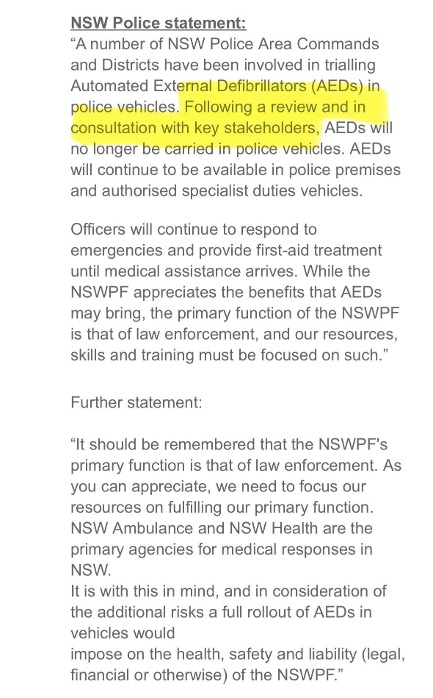
I have been asked
- Would you be able to explain the liabilities and WHS issues that the NSW police would have?
- Would this be true for all employers ?
- Would liability extend to public access defibs?
I of course cannot speak for NSW Police nor identify the particular risks that they had in mind.
I’m not sure what the WHS risks are. The risk of some sort of emotional trauma to police if they have to use an AED would be balanced one assumes by the risk to police if they need to use an AED but don’t have one. And in terms of the traumatic experiences police have I would have thought this would be the low end of the risk scale.
I can understand that there would be a risk (risk being the impact of uncertainty on objectives) to police core duties. Police need to be doing law enforcement so they may need to be arresting suspects or collecting evidence, doing crowd control and leave the first aid and CPR to others. That is however a low risk as I would expect that police already do attempt CPR and first aid if there is no-one else on scene and that risk is not made greater, or lesser, by the presence of an AED.
I do note that they refer to ‘… liability (legal, financial or otherwise)’ (emphasis added). Presumably financial liability includes the cost of buying and installing the AEDs and ensuring their maintenance and replacement of consumables if they are in fact used. I don’t know how many vehicles NSW police have but I’m sure it’s a lot and putting an AED in each vehicle would be a substantial cost. Even if an AED is used to save a life, most will never be used. That would be a substantial cost and from a government perspective, duplication when the NSW government already puts defibrillators in ambulances and probably most Fire and Rescue, RFS and SES vehicles. The NSW Police is part of the government’s response as are those other agencies, so the government is making a significant investment in the technology and it may be that there is little need to duplicate that investment.
The statements says (emphasis added):
It should be remembered that the NSWPF’s primary function is that of law enforcement. Aas you can appreciate, we need to focus our resources on fulfilling our primary function. NSW Ambulance and NSW Health are the primary agencies for medical response in NSW. It is with this in mind, and in consideration of the additional risks of a full rollout …
Whatever risks they see (and I don’t know what they are) they are secondary to the resource question and that, presumably, raises the question ‘why divert a significant amount of the NSWP budget to AEDs when any one AED is unlikely to be used?’ The money spent on AEDs is money not available to spend on other assets essential to their core function of law enforcement.
It should be noted that if the Automated External Defibrillators (Public Access) Bill 2024 (NSW) becomes law, it will require that a defibrillator is fitted in every NSW Police vehicle (see s 2(1) and s 4(2) definition of ‘relevant vehicle’ and Sch 2 definitions of ‘emergency service organisation’ and ‘emergency services vehicle’).
Conclusion
Apart from the financial risk I have no idea what risks the police think they face. Neither the presence, nor absence, of an AED in a police car will create any significant legal risk. And if it’s true that not having an AED will not create a legal risk, you can see why the financial risk becomes the dominant consideration.
POSTSCRIPT
The website Police Car Index says the NSW ‘police fleet totals 3300 vehicles. It is the largest NSW Government fleet and the biggest police fleet in Australasia.’ If we allow $2000 for an AED that is 3300 x $2000 or $6.6 million – a significant investment out of the police budget – a lot of salaries, or overtime, or other equipment, if the police are not specifically funded for that by the government.
A comment I saw in linkedIn (albeit relying on ChatGPT so it may be right or it may be entirely fanciful) said ‘About 2% of AEDs actually get deployed in anger; How ever an American study found about 6 % of police owned AEDs are used in anger …’ If that’s true 6% of 3300 is 198, that’s $6.6m/198 or $33,000 for each AED that actually gets used and given a lot of the time ambulance, or a fire brigade, or a public AED won’t be far away that is a lot of money from the police budget. We really can ask ‘what price a life?’ (and if you think we can’t ask that question, then why not put an intensive care paramedic in every police car?) If finance is their primary concern or risk, it is hard to say it is an unreasonable decision.

Proudly supported by (in alphabetical order) the Australasian College of Paramedicine, the Australian Paramedics Association (NSW), the Australian Paramedics Association (Qld), Natural Hazards Research Australia, NSW Rural Fire Service Association and the NSW SES Volunteers Association. I am responsible for the content in this post including any errors or omissions. Any opinions expressed are mine, and do not necessarily reflect the opinion or understanding of these supporters.
This blog is a general discussion of legal principles only. It is not legal advice. Do not rely on the information here to make decisions regarding your legal position or to make decisions that affect your legal rights or responsibilities. For advice on your particular circumstances always consult an admitted legal practitioner in your state or territory.
 Australian Emergency Law
A quick search shows a reasonable amount of media coverage in recent days about this issue. (Search NSW police AED, last week). The Heart Foundation is unhappy with the messaging in that their belief is that AEDs require no training, and very easy to use and just listen to the “shouty machine”. I’m sure the political issues will get sorted out with the NSW premier expressing “disappointment” when queried about it whilst opening the new Macquarie Fields ambulance station. The NSW Police association is backing the move by NSW Police, so watch this space!
Interesting. Their law enforcement duties don’t seem to stop them running into burning houses to save lives.
There is risk in comparing police AED deployment in the US and that in Australia. I believe that AED deployment in police has been a strategy in the US longer than in Australia. The US often relies on fire and ambulance services, which are voluntary (more so ambulance than fire), especially in rural areas, whereas policing is always provided with salaries staff and may have faster response times. The models of service delivery vary widely in the US, so I am not making that as a global statement, but more to say that small targeted police deployment strategies have been successful in addressing particular local resourcing needs. Emergency service delivery in Australia tends to be more uniform, at least in system design, and anecdotally, when I was in rural paramedic practice in Australia, ambulances would routinely attend a medical emergency before police, which may not be the case in the US. I do think that there should be some transparency in the police decision so we can understand the resourcing argument.
It is also worth noting that with the widespread deployment of AEDs in the community, not having one in the vehicle does not necessarily mean police would not have access to an AED. There is nothing stopping police using one of many databases or apps to locate an AED and either collect it in route or instruct a bystander to collect it, allowing the police officer to utilise an AED in the cardiac arrest. For example, if police became aware of a cardiac arrest near their station, and that they will attend faster than ambulance or other services, there is nothing stopping them from taking the station AED with them.
the real issue seems to be missed by the blog.
Should an AED have been removed or not be available because it was in a specialist vehicle AND a serving NSW police officer was to sustain a sudden cardiac arrest AND there was someone who has completed a first aid course (which as part of thier training everyone completes AED training as part of thier CPR component and it was not available AND there was not an AED available or there was a delay in the NSWAS service being able to respond because of distance / workload / ramping THEN:
there might be significant ramifications for the NSW police service failing in its duty of care under OHS legislation AND
I would hate to be the manager responsible for the decision BUT
the NSW coroner would eat them alive!
I cannot agree with that analysis. First the WHS Act requires the PCBU (in this case the state) to take practical steps to mitigate risk. The first step is to consider how likely an event is. The scenario you’ve described is not improbable but depends on multiple issues to line up. There is in fact no guarantee that anyone will actually think to use an AED and even though they do increase the chance of survival, they do not guarantee it. So no-one could say that the presence of an AED in any particular event would mean a different outcome. And the inference in this press release is the NSWP have done a risk assessment which is what is required. People get into trouble for not considering risk rather that coming to a conclusion that others may not agree with.
Finally when does the coroner ever ‘eat’ anyone ‘alive’ (see https://australianemergencylaw.com/2018/12/01/first-aid-and-paramedic-care-and-coroners-are-not-out-to-get-you/). The worst the coroner could do is recommend that the state reconsider the decision. Remember coroner’s cannot find anyone guilty of a crime or determine whether there has been negligence. They can make recommendations.
I agree in total to you response. Police are trained in First Aid and AED training is had. Taking AED out of vehicles puts its officers at risk which is a breach of section 19 WHS Act.
I would suggest this would be a union issue not wanting Police to become medical assistance when an ambulance is not available. However, the other emergency services all carry these AED’s so they could be responded firstly.
That analysis is not correct. Section 19 of the WHS Act says that a PCBU must take reasonably practical steps to ensure the health and safety of their workers. Where it comes to a compensation for heart disease or heart attack, an applicant has to show that ‘the nature of the employment concerned gave rise to a significantly greater risk of the worker suffering the injury than had the worker not been employed in employment of that nature.’ The presence or absence of an AED makes no difference to the risk of someone having a cardiac arrest.
In WorkCover Authority of New South Wales (Inspector Keelty) v Crown in Right of the State of New South Wales (Police Service of New South Wales) (No 2) [2001] NSWIRComm 90, NSW police were charged with breaches of the Occupational Health and Safety Act 1983 (NSW) over alleged inadequacies in the firearms and communication equipment issued to police. The case arose after the tragedy in Crescent Head where two police officers were shot and killed. The prosecution case was that if the police had been issued with speed loaders, or semi-automatic pistols they would have had a better chance of responding to the offender. The court said (at [31]):
With respect to the allegation that police should have been issued with 15 shot Glock pistols rather than the then standard issue 6 shot revolver, the court said (at [33]):
(In Workcover Authority of New South Wales (Inspector Keelty) v Crown in Right of the State of New South Wales (Police Service of New South Wales) (No 3) [2002] NSWIRComm 1 (7 January 2002) the charges relating to the inadequacy of the communication equipment were withdrawn and the State entered a plea of guilty to a charge that ‘concerned the training of the two police officers in tactics to be used in high risk situations’. The State was found guilty and fined $220,000 with the money to paid to the prosecutor ie the WorkCover Authority so the state paid $220,000 from its revenue to a state agency that it already paid for).
In the context of this post, the presence of an AED makes no difference to the risk that a police officer or anyone else may have a sudden cardiac arrest, but it may affect their chance of survival.
The decision to withdraw the AED is unlikely to be a breach of s 19. It is more likely to be a breach of the Work Health and Safety Regulation 2017 (NSW) r 42 which imposes a duty on a PCBU to ensure first aid is available to workers along with the provision of appropriate first aid equipment. But that does not mean anything you can think of. The First Aid Code of Practice talks about first aid kits and what should be in them, but it does not recommend AEDs. The police can show they have complied with r 42 if they comply with the Code which requires them to assess the risk.
Remember that the NSW Police are in fact the NSW Government. The NSW Government can look at the risk and ask how many police suffer cardiac arrests? How often are police first on scene at cardiac arrests? If they’ve had a trial, how often were AEDs used? How often were they successful? The Government can also rightly say that part of the way we address the risk is by operating an ambulance service with specialist health care professionals who can attend. That is also part of its response to the risk. If they have gone through the process outlined in the Code of Practice and come to the conclusion the cost exceeds the benefit then they can choose not to put AEDs in police cars and have not breached the Act or its regulations.
It must be the case that the police, or any employer/PCBU, does not have to do everything that could conceivably lead to a better outcome. If every police officer was also trained as a paramedic, and every police car was equipped with the sort of equipment found in a rapid response ambulance, then there would be better outcomes for people who the police go to assist but no-one would think that is reasonable, even if in some or even one case you can show it would have made a difference. Equally it is probably not reasonable to put a paramedic in every police car, or a police officer on every ambulance. A PCBU does not have to employ paramedics in their first aid room even if that could lead to better outcomes in some cases compared to having staff with senior first aid certificates. It follows that just because someone can identify a step that may lead to better outcomes, it does not mean that a PCBU is legally required to implement them. The NSW Government is not required to devote all of its budget to emergency health care even if that would improve the outcome from those suffering emergencies. The police are given a budget and they have to decide how to allocate that budget taking into account all the things the police are required to do and their primary role is law enforcement.
This blog is about the law, not the moral issues. Legally police are not breaking the law if they have done a risk assessment and come to a conclusion that AEDs in all police cars in not a reasonably practicable response. That conclusion can include a cost benefit analysis. It may be that it’s a morally reprehensible decision (a matter I make no comment on) but it is not a breach of s 19 of the WHS Act and is unlikely to be a breach of r 42.
Are they still equipped with fire extinguishers? ð¤
DJ
Dave Jones (He/Him)
Senior Team Manager – East Gippsland
Bairnsdale â Lakes Entrance â Paynesville â Orbost
Ambulance Victoria
I’m not sure how much more clarity people need. Or more so the morons within NSW Police trying to justify this.
see below for Part 6 of the Police Act 1990. Specifically 3 (b). They have a duty and obligation as per the Act. Not negotiable. This is the work of some lame senior officer trying to find things to blame for their failure to retain and recruit staff. Saving a human life should be the ultimate measure of success. Not something to blame for taking away from other duties….
Mission and functions of NSW Police Force
I don’t think it as simple or obvious as you suggest.
‘The mission of the NSW Police Force is to work with the community to reduce violence, crime and fear’ (Police Act 1990 (NSW) s 6(1)). One of its functions is to provide police services (s 6(2)(a)) and that includes ‘prevention and detection of crime’ (s 6(3)(a)) and ‘the protection of persons from injury or death, and property from damage, whether arising from criminal acts or in any other way’ (s 6(3)(b)) but that does not compel the police force to also operate a fire brigade and an ambulance service even though those services protect persons from injury and death. The Act says (s 6(5)) ‘The provision of police services in emergencies and rescue operations is subject to the State Emergency and Rescue Management Act 1989 …’ and that Act sets out the areas were the lead is taken by the other services, including NSW Ambulance and NSW Health. So no, the first duty of NSW police is not to ‘preserve life’ that is one of its functions but it ranks equally with its other functions and how it does that is with due recognition to the role and expertise of the other state run emergency services.
Further the fact that the police have the function of protecting persons from injury or death does not equate to a legal duty to do that or to do that in any particular way (Civil Liability Act 2002 (NSW) s 46). That this is a function means that if the police choose to spend their budget on AEDs what would be a legitimate expenditure but it does not mean they must spend their money on them. There are lots of ways police can act, lots of things they can do to meet all their functions and they have to make decisions as to how to allocate their resources across all their functions (Civil Liabilty Act 2002 (NSW) s 42). What s 3(b) means is that the police could choose to put AEDs in all police vehicles, not that they have to.