Discussion on the law that applies to or affects Australia's emergency services and emergency management, by Michael Eburn, PhD, Australian Lawyer. Email: meburn@australianemergencylaw.com
I’m asked if I have ‘any thoughts on the proposed legislation for the Qld SES? In particular how does it compare to the other states and territories?’ The Bill is the State Emergency Service Bill 2023, introduced to the Parliament on 28 November 2023.
I’m not going to go through the bill section by section. With a brief overview it looks consistent with legislation in other states and territories. Nothing ‘jumps out’ as a great innovation or a bizarre departure from standard, with one exception.
The Act provides for a Commissioner, who will be responsible for (s 9):
(a) the establishment of SES units and the designation of areas for SES units; and
(b) the appointment of persons as SES chief officer, local controllers, SES commanders and other SES members; and
(c) the establishment of management and support services for the SES; and
(d) the development of policies to help the SES perform its functions effectively and efficiently including, for example, policies about training SES members; and
(e) the giving of directions and guidance to the SES chief officer, local controllers, SES commanders and SES members; and
(f) the performance of any other function relating to the SES that is given to the commissioner under this Act or another Act.
The Chief Officer, appointed by the Commissioner is (s 13):
(a) to manage the SES in a way that ensures the SES operates effectively and efficiently;
(b) to comply with any direction given by the commissioner that is relevant to—
(i) the functions of the SES chief officer or the SES; or
(ii) SES members;
(c) to perform any other function relating to the SES given to the SES chief officer under this Act or another Act.
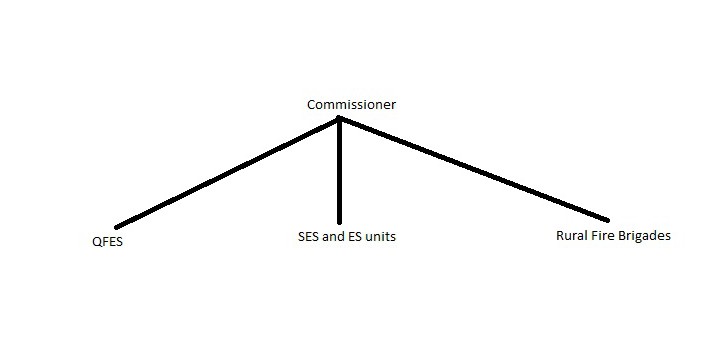
We can describe the relationship as three services, all lead by the same Commissioner, but not the same service.
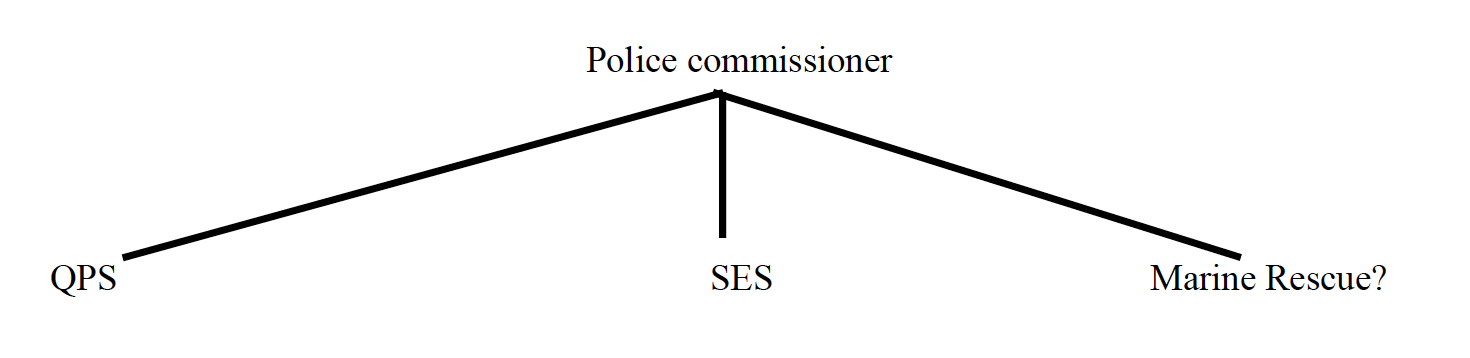
Under the new system the diagram will be similar but it will be the police commissioner at the top:
Having a single commissioner is not unique, for example the emergency services in the ACT are led by the Emergency Services Commissioner with each service having a chief officer. In Victoria there is the Emergency Management Commissioner. In Western Australia the Fire and Emergency Services Commissioner exercises functions for the SES, Volunteer Marine Rescue as well as the urban and rural fire brigades.
What is unique for Queensland is that it is the police commissioner taking on thise role. Personally, I think of police as law enforcement. If we accept that emergency management is itself a professional role – extending beyond response – then it seems more fitting to have an emergency management commissioner rather than a police commissioner at the top of the pyramid.
In a submission to the inquiry into the 2022 NSW floods, the NSW Police Association said (emphasis added):
We submit there should be one agency always responsible for the control and coordination of emergency response operations. The consistent performance of this role by the same agency will ensure there is no ambiguity regarding who is in control; it is not dependent on circumstances and therefore no confusion over who is controlling and coordinating operations. It also means that agency will have the greatest level of experience and knowledge to perform the role in all emergency situations.
The FBEU maintains that the most appropriate agency to undertake this work is FRNSW as they have the capability and structures in place to deliver the required response functions in emergencies of this nature.
It appears that Queensland has experimented with having the SES as part of a larger Fire and Emergency Service but is now shifting to have it as part of an expanded police and emergency service. Whether either is a better fit, or whether the SES should (as it currently does in NSW) stand alone remains to be seen.
Qld disaster management arrangements have QPS as lead agency for disasters in QLD hence the change where fire will be under the QLD fire department (FRQLD and RFS) new legislation coming.
I also believe that all water borne rescue will also fall under QPS ie SLSQLD and QLD Marine Rescue (Vol Cloast Guard)


 Australian Emergency Law
Qld disaster management arrangements have QPS as lead agency for disasters in QLD hence the change where fire will be under the QLD fire department (FRQLD and RFS) new legislation coming.
I also believe that all water borne rescue will also fall under QPS ie SLSQLD and QLD Marine Rescue (Vol Cloast Guard)