
This question comes from a NSW paramedic who is concerned about:
A treating doctor requesting lights and sirens transfer of a patient from one hospital to another for definitive care. The reason for the urgency is (ideally) based on the patient’s condition. Many of our hospital colleagues are not aware of the skills and procedures we have at our disposal and this can sometimes influence their request for urgent transport. And sometimes, it’s just because. In the event of the reasons being other than patient based, I would like to ensure that the paramedic has the legal authority (indeed, the responsibility!) to make the decision to drive under normal conditions.
Our circulars just refer us to the Australian Road Rules and Traffic Act 1909. I am led to believe that the paramedic cannot be instructed to expedite by an external party when it’s not essentially required, but I can’t find it. On the assumption that “it” actually exists of course!
It’s a worry if the circulars that are given to my correspondent refer to the Traffic Act 1909 (NSW). This Act was repealed on 30 November 1999!
This question does raise issues that I have addressed, in different contexts, in:
- Road traffic exemption – Who determines if it is reasonable that the provision should not apply? (May 22, 2016); and
- Transporting a Queensland prisoner by ambulance – and stopping at an accident (July 1, 2016).
We’re never going to find a rule that says ‘a paramedic cannot be instructed to expedite by an external party’. No-one can instruct anyone to do anything unless the person giving the instruction has some lawful authority. For a third party to be able to instruct a paramedic you would need a rule saying that the third party had authority, not a rule saying that they do not. So ‘it’ – a rule ‘that the paramedic cannot be instructed to expedite by an external party when it’s not essentially required’ will not exist.
So let us look at the rules. We know that rule 306 of the Australian Road Rules (incorporated into NSW law by the Road Rules 2014 (NSW)) provides an exemption from the other road rules where it is ‘reasonable’. We also know that the rules don’t specifically say who gets to decide whether or not it is reasonable in the particular circumstances. That is because it is ultimately, up to a court. If the rule said that it was the driver, or the services opinion that counted, then that decision could not be challenged. By saying that rule 306 applies in circumstances where ‘the driver is taking reasonable care’ and ‘it is reasonable that the rule should not apply’ the final arbiter in any given case is the court (see Road traffic exemption – Who determines if it is reasonable that the provision should not apply? (May 22, 2016)).
To revisit the question – what is really being asked is ‘is it reasonable that the other road rules should not apply – or that rule 306 should apply – because a doctor has indicated that the need for patient transfer is urgent?’ The answer has to be ‘no; that on its own is not sufficient’.
First the doctor may be expert in assessing the patient’s condition and the need for transfer to definitive care but he or she is not an expert on driving and in particular on the road conditions that are applying at the very time that the transfer is occurring. So, for example, the doctor might say I want a ‘lights and siren’ response but that will be irrelevant if the driver finds themselves stuck in traffic due to a protest. The doctor can’t say ‘just run those people over because I want this transfer to be urgent’ – the doctor can want what he or she wants but that doesn’t mean it can be provided. Whether it’s a risk to pedestrians or other drivers, the driver of the ambulance has to balance all those factors to determine what ‘urgent’ means.
We are reminded that an ambulance is not a taxi – and paramedics need to believe that.
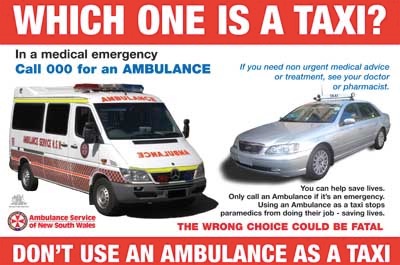
If it is believed that a doctor can direct the paramedic how to drive, or when to use lights and sirens, that’s behaving more like a taxi service, not a professional health care service; see Transport everyone or act as a professional? A question for paramedics (May 6, 2013) (and even with a taxi, the passenger can’t tell the driver how to drive).
In Transporting a Queensland prisoner by ambulance – and stopping at an accident (July 1, 2016) I said:
As for the prison guard’s instructions, the prison service doesn’t own the ambulance and the ambulance crew aren’t subject to the prison guard’s direction and control. It is not for the prison guard to tell the driver of an ambulance what he or she is ‘permitted’ to do. Imagine, if you will, you are transporting a person to hospital ‘for medical review and treatment’ and you are involved in or observe an accident where someone is injured. Would you allow the patient’s family to tell you ‘you are not permitted to stop’ because they think their family member’s needs, or worse, their own needs are more important? The answer is ‘no’ and the prison guards are in the same position. It’s not like a taxi service where having hired the taxi I can say whether or not the taxi driver can take on a multiple hire (Transport Operations (Passenger Transport) Regulation 2005 (Qld) s 66) so I can’t tell a paramedic not to treat an injured person because I, or my loved one, or my prisoner, got into the ambulance first. And if I hire a taxi, I can’t tell the driver to keep going after he or she has been involved in an accident because me getting to where I want to go is more important than the needs of the injured. The guards are there to secure the prisoner not tell the paramedics how to treat them or how to drive. If the prison service wants to give those sort of directions it should buy its own ambulance and employ its own paramedics, but even then the prison service couldn’t give instructions to ignore the provisions of the Transport Operations (Road Use Management) Act.
A similar statement can be made here. As for the doctor’s instructions, the doctor or health service doesn’t own the ambulance and the ambulance crew aren’t subject to the doctor’s direction and control. It is not for the doctor to tell the driver of an ambulance what he or she is ‘permitted’ or required to do. If the health service wants to give those sort of directions it should buy its own ambulance and employ its own paramedics.
As I said in Road traffic exemption – Who determines if it is reasonable that the provision should not apply? (May 22, 2016):
Where does the caller, whether it’s a citizen who calls triple zero or a doctor fit into that list? The answer is ‘they don’t; they don’t get to decide what response is required’. This goes back to my first decision maker, the relevant service. They should have a policy and it may be that they have a policy that a doctor can request an ambulance and if the doctor says the request is ‘urgent’ then the ambulance service will direct its officer to ‘respond’ with lights and sirens. But it’s the service, not the doctor that is making that decision. If a doctor is travelling with the patient and paramedics and expresses the view that the urgent nature of the patient’s condition requires an expedited response, he or she can ask for that to happen, but the doctor cannot direct the driver as to how to drive or to ‘turn on the lights and sirens’.
And if the reason for the request is ‘other than patient based’ then it can’t be the case that it is reasonable for r 306 to apply.
Conclusion
A doctor can request an urgent response but cannot require it. One can’t find a rule that says that – but if the law was that a doctor can require an urgent response there would have to be a rule to gives that authority to the doctor; and there isn’t one. Rule 306 does not say it applies ‘when a doctor says it does’; it says it applies when it is reasonable in the circumstances. The doctor’s request is only one of those circumstances as is the patient’s need, the care that the paramedics can provide en route, the traffic conditions and the need to take care to avoid harming other road users and the patient.
 Australian Emergency Law
It’s good that the paramedic sought advice or discussion here. But the issue needs to be cleared up by a) his/her employer procedures or protocols and b) co-ord, when in doubt get instruction from co-ordination centre and or Duty Supervisor, even if it’s to back up your decision.
Additionally, here it was observed that if the health services wanted to instruct paramedics what to do, they’d need to own and operate their own ambulances and paramedics.
The health service does in fact own its own ambulances and paramedics – the New South Wales Ambulance Service – is owned and operated by NSW Health.
I’d agree that the doctor couldn’t order an operational instruction – in this case the way the ambulance is to be driven, but doctors are doctors and they hold a clinical sway over the paramedics.
NSW Health also owns it’s non-emergency patient transport service. On many occasions (in my experience plus other staff anecdotal evidence) Doctors assume that the NEPT service will be able to transport patients of almost any category including high acuity (these are requiring care or intervention in transit – Paramedic skills required) and have complained “but you’re patient transport, why have you if you can’t take this patient?”
Let the attending agency determine what’s appropriate for transport conditions
And doctors and hospitals need to understand NSW health directives better on patient categories when wanting a certain type of care or type of transport, expedited or not.
Its true that NSW Health, the government department, operates NSW Ambulance and the various health services. But each is a seperate legal entity. The Health Services Act 1997 (NSW) s 17(2) says that each ‘local health district is a body corporate’ ie it is a seperate legal entity that can sue and be sued. The ambulance service is not a seperate legal entity, so the Crown in right of NSW operates the ambulance service, but each health service eg the Sydney Local Health District is a seperate legal entity. So the health service the doctor works for does not own the ambulance service.